

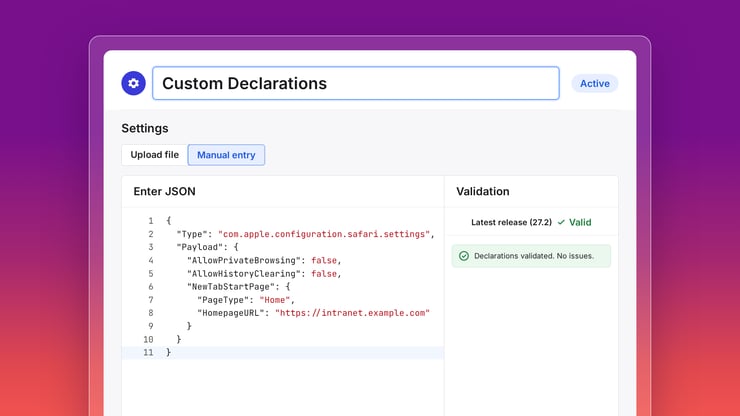

Iru now supports Custom Declarations for Apple. Add a new Custom Declarations Library Item, paste or upload your Apple declarations JSON, assign it to devices, and Iru handles real-time validation and reporting. That’s it.
Credit where credit is due: Apple continues to push the boundaries of what modern device management looks like. Between major OS releases, rapid beta cycles, and foundational architecture shifts, their ecosystem evolves at a blistering pace.
In an enterprise environment, meeting that momentum requires Day-0 agility. When Apple introduces new management capabilities, security controls, or posture baselines, IT and security teams want the freedom to test configurations immediately, integrate them into testing pipelines, and roll them out on their own terms.
To put that speed and flexibility directly in your hands, we’re releasing Custom Declarations. It gives you access to Apple’s latest management controls, safely, and right the first time.
Author your DDM payload
Custom Declarations provides a dedicated conduit to DDM without waiting for pre-built interface controls. Admins can add declarations by either pasting raw JSON into the editor or uploading .json files directly to a new Library Item. A single Library Item can house one or more declarations, with each declaration parsed, tracked, and managed as an independent unit.
Declarations are standard JSON, you can also bring the ones you’ve already built, whether you wrote them by hand, generated them with an AI tool, picked them up from the Mac admin community, or exported them from another management platform.
Delivery context is configured explicitly per declaration rather than inferred, allowing admins to designate whether a payload applies to the device channel for system-level controls or the user channel for user-specific configurations.
Support for self-hosted custom asset declarations is planned for a future release.
Validate before deploying and catch what other tools miss
Deploying raw JSON to production fleets introduces risk if payloads contain syntax errors or schema mismatches. Here’s the problem: many tools accept a malformed declaration without complaint, and admins only find out when it never reaches their devices. Our Custom Declarations Library Item builds structural validation into the workflow before any configuration can be saved or assigned.
As you paste or build a declaration, the editor parses the payload for well-formed JSON, surfacing immediate inline syntax errors if the formatting is broken. The payload is then validated directly against Apple’s declarative device management schema specifications. Iru verifies that the declaration maps cleanly to an authorized declaration type (configuration, activation, or management) and halts the save if required top-level keys or structures are missing.
Additionally, Iru checks for identifier collisions against existing declarations across your library, preventing accidental silent overwrites on managed devices. If a declaration duplicates something an existing Iru Library Item already does, Iru points you to that Library Item instead.
Roll out controls to your fleet
Custom Declarations are assigned to devices and device groups through standard Iru Blueprints, so teams can incorporate raw DDM controls into their established fleet baselines.
At assignment time, Iru handles the underlying mechanics of DDM by automatically generating the necessary activation declarations for each configuration. This removes the administrative overhead of constructing activation payloads manually when conditional logic or predicates aren’t required.
When a device becomes eligible for an assigned declaration, Iru delivers it automatically. A device upgrades to an OS that supports a new control? Iru picks up the change and sends the declaration. No manual retries. No reassignment. It’s already handled.
When an assigned declaration is updated in the Library, the modified payload redeploys to target devices under the existing identifier to preserve continuity. Removing a declaration triggers a destructive un-assignment flow with explicit confirmation, retracting the payload from endpoints cleanly.
Every lifecycle event, from creation and updates to assignment and deletion, is exposed via Iru’s APIs and logged to the Library Item activity audit trail.
Real-time DDM status reporting, not generic timeouts
Legacy MDM workflows frequently mask configuration failures behind generic timeout errors or indeterminate states. Because Custom Declarations integrates with Apple’s dedicated DDM status-channel subscription model, telemetry is surfaced directly from the OS.
Admins can monitor real-time delivery status for each assigned device across pending, delivered, and error states. When an endpoint fails to apply a declaration, Iru surfaces Apple’s raw, unparsed error text rather than abstracting it into generic platform codes. If a device rejects an unsupported key or encounters an internal OS conflict, the console reflects the exact operating system failure message.
Delivery status is tracked independently for device-channel and user-channel declarations, providing clear visibility into which specific execution context succeeded or failed.
Bring DDM capabilities to your fleet on Day 0
Custom Declarations is designed for teams that require immediate access to Apple’s latest DDM payloads. Safely test, deploy, and monitor Apple’s newest management controls the moment they’re documented, within 24 hours of Apple publishing them.
Iru’s validation pulls directly from Apple’s published device management schemas, so new declaration types, including those in Apple’s beta releases. When WWDC brings a new set of declarations, you can start testing them the next day.
Innovation shouldn’t have to wait. With Custom Declarations, your fleet never has to.