
 Workforce Identity
 Endpoint Management
 Endpoint Detection & Response
 Vulnerability Management
 Compliance Automation
 Trust Center


Iru and Hexnode both manage your fleet from a single console. The difference is scope: Hexnode is a proven unified endpoint manager (UEM) built to manage the widest range of device types, while Iru is a broader IT and security platform that integrates identity, endpoint security, and compliance into a single system.
That makes the Iru vs. Hexnode choice less about which manages devices better and more about how much you want one platform to do. Below, we compare both across device management, security, identity, and compliance, so you can decide whether a dedicated UEM is enough or whether consolidation wins.
At a glance: Compare Hexnode and Iru
Here’s a quick overview of both Iru and Hexnode:
| Iru | Hexnode | |
|---|---|---|
| Purpose | AI-powered platform for endpoint management, identity, and compliance automation | Unified Endpoint Management (UEM) platform for cross-platform device management |
| OS support | Mac, Windows (agent-managed); iOS, iPadOS, Android, Apple TV (MDM-only) | iOS, Android, Windows, macOS, Linux, ChromeOS, tvOS, FireOS, Android TV |
| Device configuration | Blueprint-based with Assignment Maps and conditional logic; one-click CIS (computer information system) benchmark templates for Mac | Policy-based configuration across all supported OS; granular profile and policy controls |
| Identity management | Native Workforce Identity, natively passwordless, device-bound passkeys, SSO, Zero-Trust conditional access, user lifecycle management | Integrates with external identity providers (Azure AD, Okta, Google Workspace); no native identity layer |
| Endpoint detection and response | Built-in EDR in the same agent as device management—behavioral analytics, Device Isolation, protect and detect modes | No native EDR; requires a separate security platform |
| Vulnerability management | AI-matched vulnerability detection with Vulnerability Response for autonomous patching across 230+ apps | No native vulnerability management |
| Compliance automation | AI-native Compliance Automation—AI-Tailored Controls, continuous evidence collection, SOC 2, ISO 27001, ISO 42001 | Device compliance and policy enforcement; integrates with external GRC tools (Vanta, Drata) for full compliance workflows |
| Kiosk and frontline device support | Standard kiosk functionality | Advanced kiosk lockdown; strong fit for retail, digital signage, and rugged or frontline device deployments |
| Pricing | Quote-based | Per-device; 4 tiers from $2.40/device/mo |
| G2 rating | 4.7 / 5 | 4.5 / 5 |
| Best for | IT and security teams that are consolidating device management and compliance | Dedicated GRC programs that need multi-framework coverage |
What is Iru?
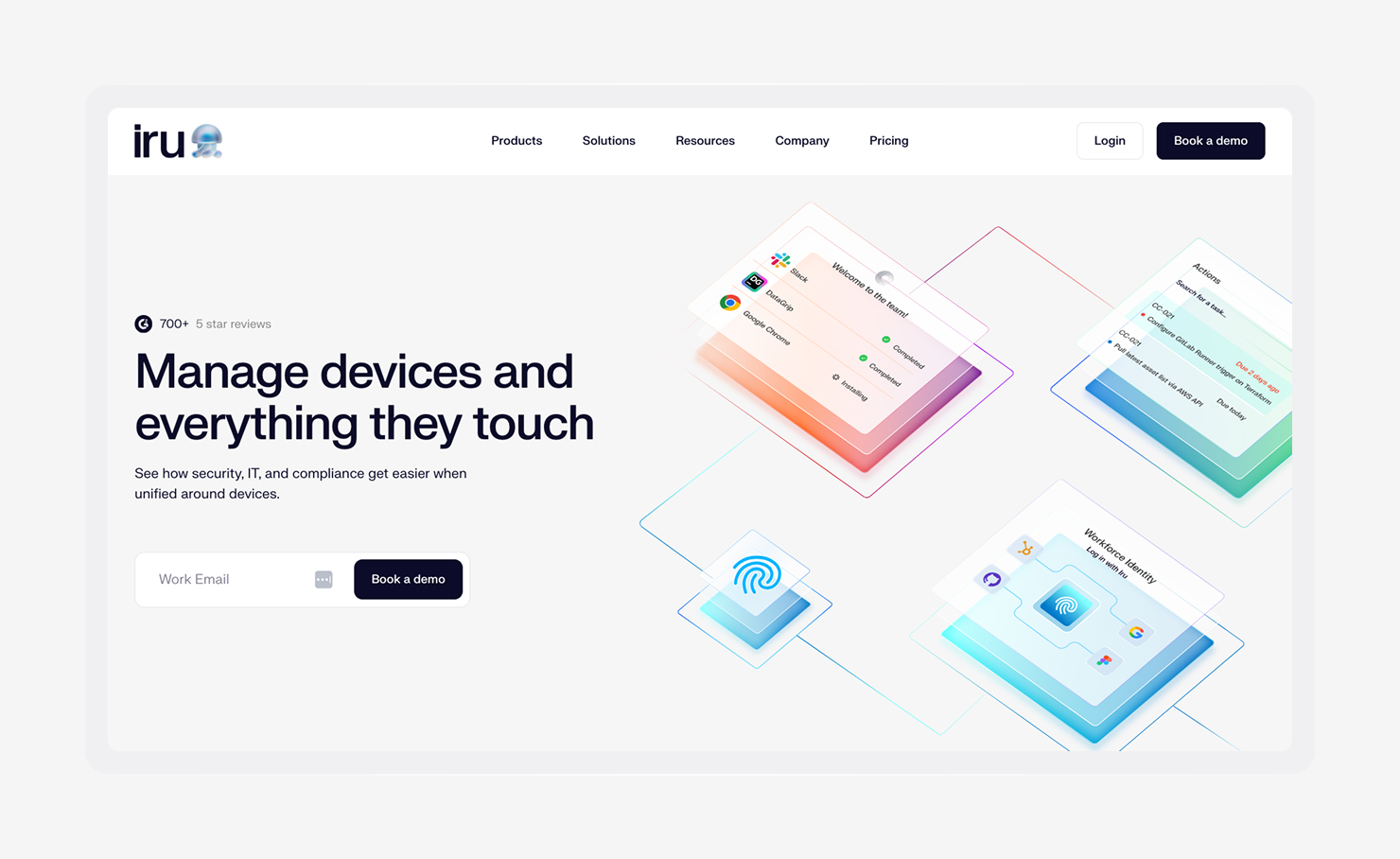
Iru is an AI-powered IT and security platform that unifies endpoint management, identity, and compliance automation in one place. The Iru Agent runs on Mac and Windows and combines device management, EDR, and Vulnerability Management in a single deployment. With no separate security agent or SKU (stock-keeping unit), iOS, iPadOS, and Android are managed via MDM.
That single-agent approach extends to upkeep and access. Auto Apps patches 230+ third-party apps automatically based on CVE severity. Meanwhile, Workforce Identity is passwordless by design, with device-bound passkeys, SSO, and Zero-Trust conditional access, so no external identity provider is required.
Compliance Automation rounds out the platform. It's AI-native, generating tailored controls and collecting evidence continuously across SOC 2, ISO 27001, ISO 42001, HIPAA, and GDPR. To connect it all together, Iru AI runs across all three capability areas.
Pros
- A single agent delivers device management, EDR, and vulnerability management, with no separate security SKU.
- Auto Apps patches 230+ third-party apps automatically based on CVE severity.
- Native passwordless identity, so no external IdP is required for the full identity stack.
- AI-native compliance automation with continuous evidence collection (SOC 2, ISO 27001, ISO 42001, HIPAA, GDPR).
- Blueprint-based configuration with Assignment Maps and conditional logic for conflict-free policies.
- Zero-touch enrollment for Mac and Windows, plus 24/5 support with sub-2-minute chat response.
Cons
- The unified agent runs only on Mac and Windows.
- Covers ten compliance frameworks natively (including SOC 2, ISO 27001, ISO 42001, HIPAA, GDPR); other frameworks require manual control creation.
- Limited support for kiosks and frontline/rugged devices.
Best for
IT and security teams that want to consolidate device management, endpoint security, identity, and compliance into a single platform, especially in Mac- and Windows-primary fleets.
Request a demo to see how Iru can help automate your compliance process.
What is Hexnode?

Hexnode is a UEM platform that manages and secures a wide range of device types from a central policy and configuration engine.
Its core strength is breadth. Hexnode supports Windows, macOS, iOS, iPadOS, Android, Linux, ChromeOS, tvOS, Fire OS, Android TV, and visionOS. It has consistent policy and profile controls across each operating system.
That range makes it a common choice for kiosk and dedicated-device deployments, such as retail terminals and warehouse scanners.
Hexnode extends past device management through separate products: Hexnode XDR for threat detection and Hexnode IdP for identity and conditional access. It also integrates with external identity providers and connects to GRC tools like Vanta and Drata to provide compliance evidence.
Hexnode UEM is priced per device across four tiers, starting at $2.40/device/month billed annually, with the top Ultra tier quoted on request.
Pros
- Broadest OS coverage, including Linux, ChromeOS, Fire OS, Android TV, and visionOS.
- Advanced kiosk lockdown for retail, frontline, and dedicated-device environments.
- Transparent per-device pricing across four tiers, starting at $2.40/device/month.
- Granular policy and profile controls across every supported OS.
- Integrates with major identity providers and external GRC platforms.
Cons
- Device management, threat detection (XDR), and identity (IdP) are separate products rather than one unified platform.
- No native compliance automation; audit-readiness requires an external GRC tool like Vanta or Drata.
- Some capabilities, such as desktop patch management and Okta device trust, fall under the Ultra tier.
- Building a full security, identity, and compliance stack means combining multiple Hexnode products or third-party tools.
Best for
Organizations managing broad, mixed-OS fleets (including Linux, ChromeOS, and frontline or kiosk devices) that want dedicated cross-platform device management.
How Iru and Hexnode compare
Iru and Hexnode overlap on device management but differ in scope. Iru's agent combines device management, EDR, and vulnerability management into a single deployment on Mac and Windows, so a compromised device can be detected, isolated, and remediated from a single tool. Hexnode manages devices via MDM and policy profiles. The company offers threat detection as part of its separate XDR product.
Iru also folds in identity and compliance. Workforce Identity is passwordless, with no external IdP required, and Compliance Automation continuously collects audit evidence across SOC 2, ISO 27001, ISO 42001, HIPAA, and GDPR. Hexnode delivers identity through its separate IdP product and leans on external GRC tools like Vanta or Drata to get audit-ready, so a full security-and-compliance stack means assembling several pieces.
Where Hexnode pulls ahead is breadth, an important aspect of a dedicated unified endpoint management platform. It supports more OS types, including Linux, ChromeOS, Fire OS, Android TV, and visionOS, and is purpose-built for kiosk and frontline deployments like retail terminals and rugged devices. Iru goes deeper on Mac and Windows with a security-focused agent, Blueprints, 230+ Auto Apps, and CIS templates, but doesn't specialize in kiosk. Hexnode fits better for mixed or frontline fleets, while Iru fits better for Mac- and Windows-primary environments where security depth matters.
Iru offers device management and security in a single platform
The Iru vs. Hexnode choice comes down to breadth versus consolidation. If you manage a wide range of device types or rely on kiosk and frontline hardware, Hexnode's UEM suite is hard to beat for device management.
If your fleet is Mac- and Windows-primary and you'd rather run endpoint security and management, identity and access, and compliance automation from one system, Iru is one of the stronger Hexnode alternatives, consolidating what would otherwise be several tools, as with switching to a modern MDM.
See how Iru brings endpoint management, security, identity, and compliance together in one platform.