 Workforce Identity
 Endpoint Management
 Endpoint Detection & Response
 Vulnerability Management
 Compliance Automation
 Trust Center




Tool sprawl is breaking IT & security teams. The data from 1,011 IT and security professionals makes the mechanism clear: the more tools a team manages, the worse everything gets. More burnout. More time on maintenance. Less time for the work that actually matters.
Who we heard from
- 1,011 total responses from IT and security professionals
- Company size breakdown: 23% from 1–100 employee companies, 37% from 101–500, 18% from 501–1,000, 15% from 1,001–5,000, and 7% from 5,000+
- 88% hands-on practitioners: 45% IT admins, 33% IT managers/directors, 11% security engineers and security leaders
- Comprehensive tool coverage: 92% use device management, 81% malware protection, 80% identity systems, 43% use compliance automation
The top challenges
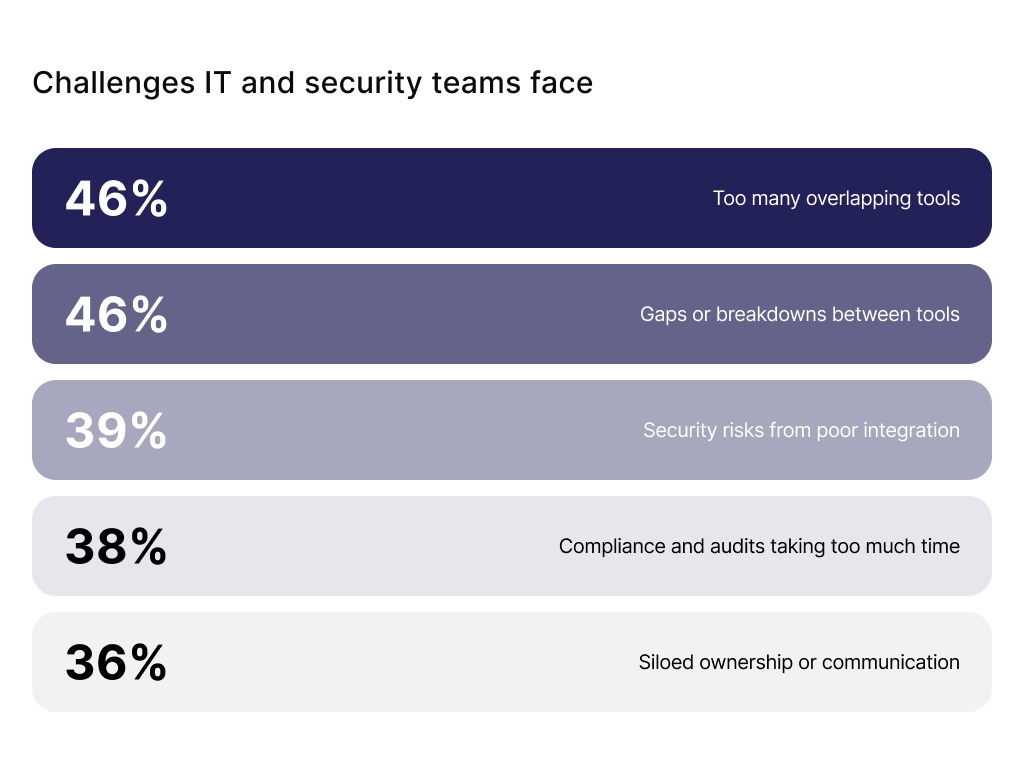
We asked teams what's making their jobs hardest. Five problems came back clearly:
The burnout-complexity connection
The numbers are stark. Teams managing 1–5 tools report 18% higher burnout. Teams managing 16 or more report 50%. The average burnout score across all respondents is 2.8 out of 5. Nearly half, 43%, report moderate impact. 20% report significant to severe burnout.
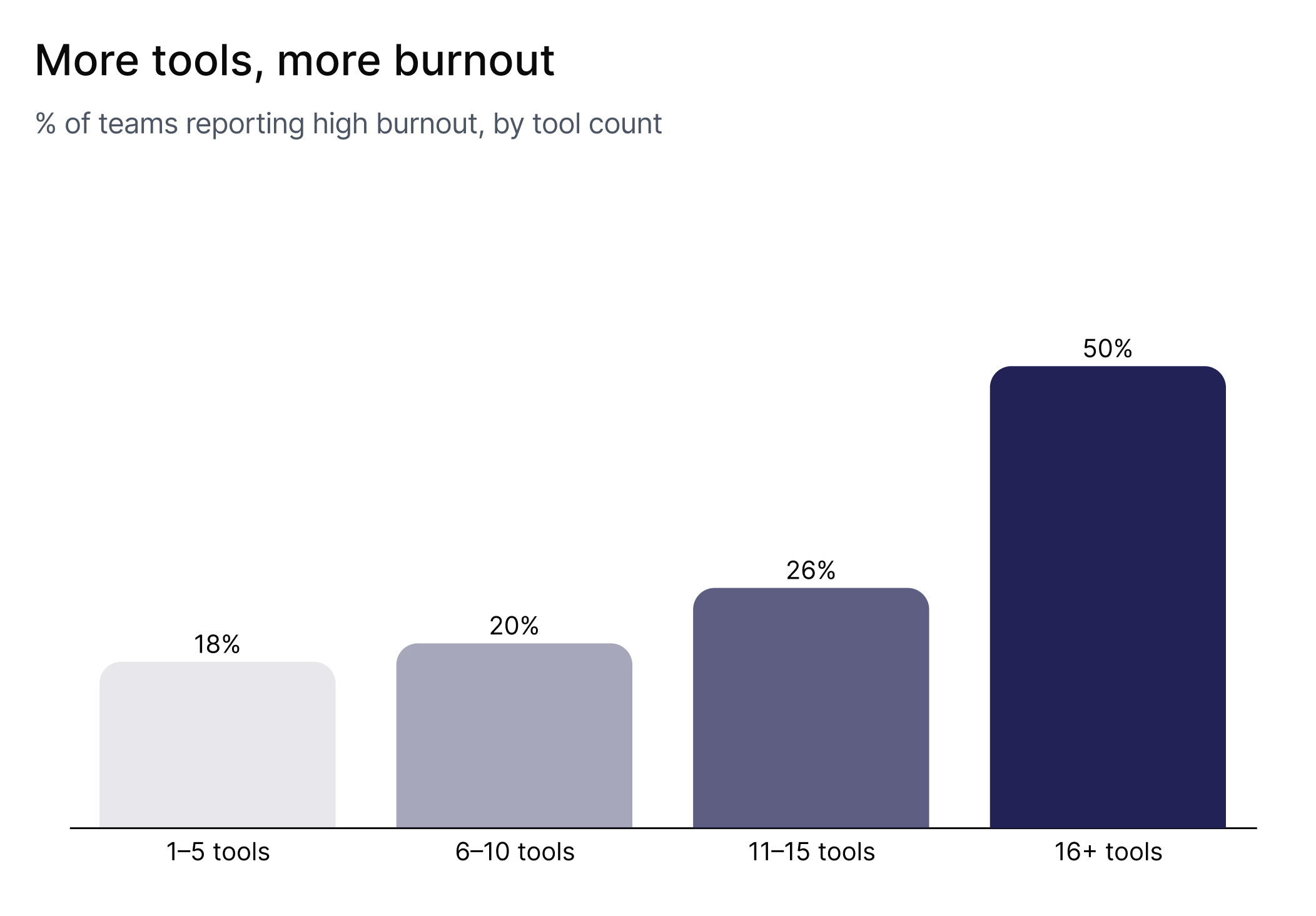
That's a direct, linear relationship between tool count and team health.
"We switched platforms last year. With our previous solution, there was major burnout amongst my team. Since making the move, that burnout is nearly gone and we're seeing the change pay dividends." — IT Leader, mid-size enterprise
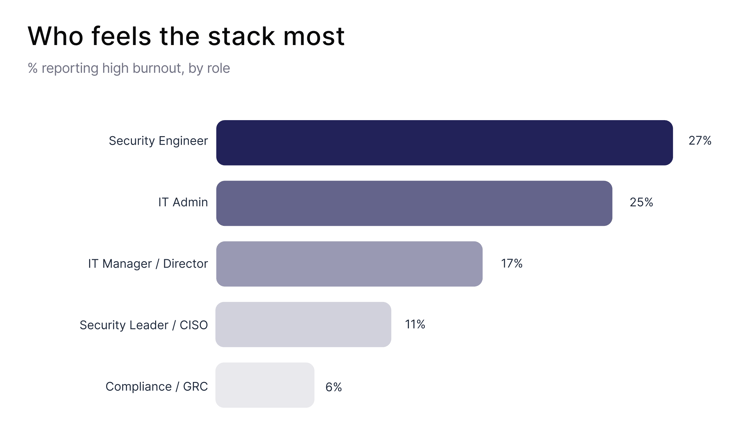
The effect hits some roles harder than others. Security engineers are the most burned out group in our data, with a 3.0 average burnout score, the highest of any role. 27% report high burnout and 44% spend more than half their time on maintenance work. The people most responsible for keeping organizations secure are also the most exhausted.
Teams running a single endpoint management tool report 18% high burnout. At three or more, that number jumps to 32%. The more tools added, the worse it gets.
Security leaders report the lowest burnout of any technical role, with 11% reporting high levels. They're not the ones resolving daily alerts or patching gaps between tools. That distance gives them the strategic view. When they push for consolidation, they push from what they see at the organizational level: total cost, aggregate risk, and the overhead fragmentation creates for everyone below them.
The mid-market problem
Companies with 101–1,000 employees are in the hardest position. They've outgrown simple solutions. They don't have the resources to manage enterprise-level complexity. They're caught in the middle.
The 101–500 segment is where the pressure peaks. 63% prioritize better integration, and 47% cite security risk from poor integrations as a top challenge, the highest of any size segment.
"Vendors either try to do too much and don't do anything well, or really focus on one thing and don't integrate well with anything else. Finding a good balance is difficult." — Mid-market IT leader
Something shifts structurally around 500 employees. Siloed communication sits at just 31% at companies under 500, then jumps to 45% at the 501–1,000 band and stays there. At 5,000+ employees the stack-level security risk concern drops to 24%, but nearly half report siloed communication as their primary challenge. The gaps move from platforms to people.
"We just have a ton of vendors. Way too many."
The IT and security divide
Both IT and security teams want better integration. Their second priorities split in a way that matters.
IT teams lead on automation: 49% put it in their ideal stack. Security teams lead on security posture: 40%. These are their role-specific priorities. IT carries the daily operational burden of keeping systems running. Security focuses on exposure and risk.
The tension between them is a design problem. Most point solutions serve one or the other. A platform has to serve both.
The maintenance trap
Here's how teams are actually spending their time:
- Only 26% focus primarily on strategic work
- 34% split time roughly equally between maintenance and strategy
- 28% spend most of their time on maintenance
- 12% are almost entirely consumed by upkeep
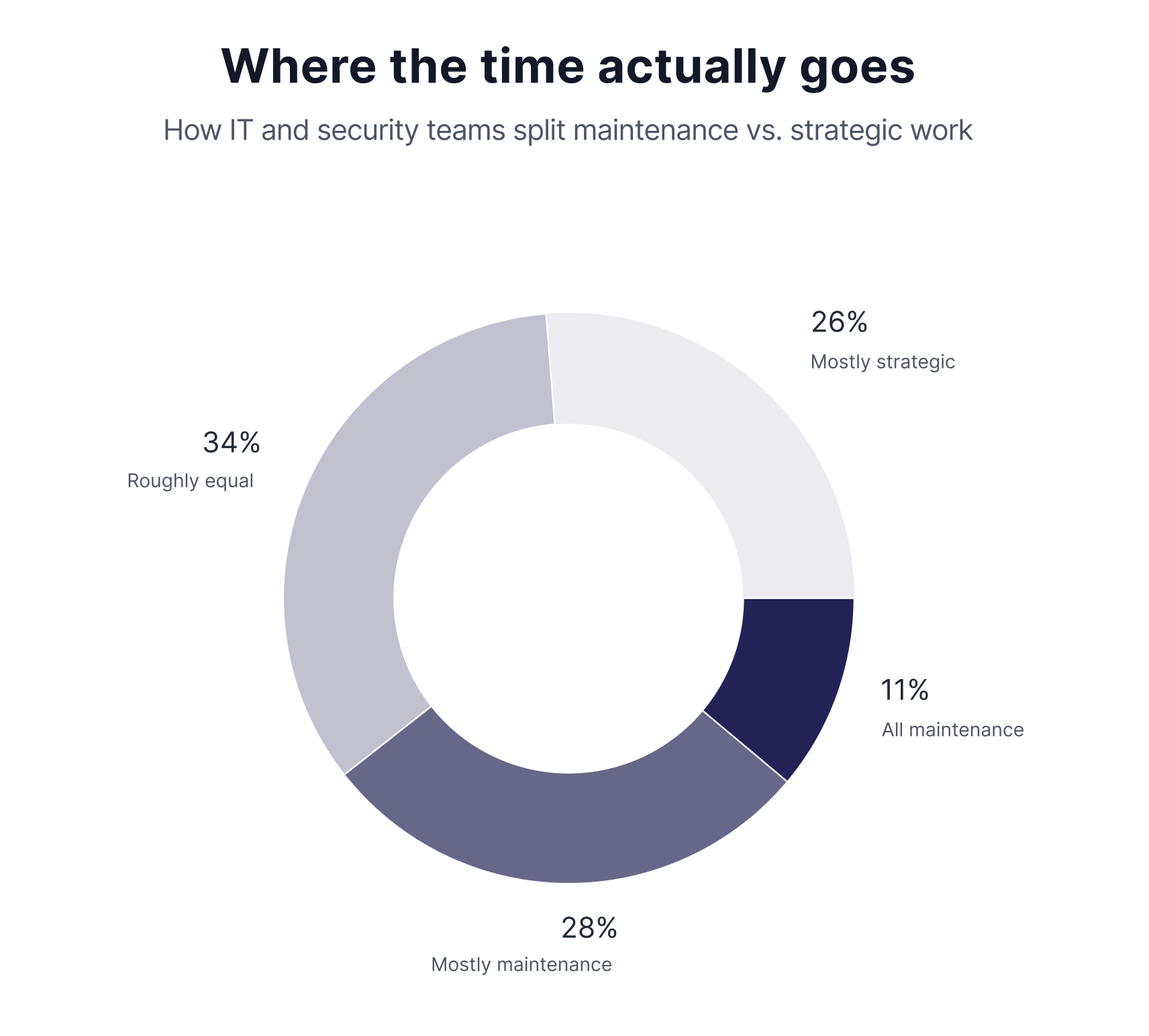
73% of IT teams spend the majority of their time keeping things running rather than making things better. The cycle is self-reinforcing. Fragmented stacks require more maintenance. More maintenance steals the time needed to consolidate and automate. Less consolidation means more fragmentation. The stack gets heavier every year.
Security engineers feel this most sharply. 44% say more than half their time goes to maintenance. The people with the least time to spare spending the most time on work that doesn't move the needle.
What teams actually want
When we asked people to describe their ideal stack, integration dominated everything else:
- Better integration between tools: 59%
- Better automation capabilities: 47%
- Lower total cost: 40%
- Unified dashboard / single pane of glass: 32%
- Fewer vendors to manage: 31%
Surprisingly, nearly twice as many respondents chose better integration over fewer vendors. When tools don't talk to each other, someone has to make them — and that someone is usually the IT or security admin switching between consoles, manually pulling data from one system into another, and filling in the gaps that no vendor covers. The integration ask is that labor, measured.
"Automation and integration are our mantra."
What this means for IT and security leaders
Four things the data makes clear:
More tools means more burnout. The correlation is direct and measurable. Tool count is the single strongest predictor of team health.
Better integration, more automation, lower cost. Teams know exactly what they need. The top priorities were specific: seamless integration between tools, better automation, and lower cost.
Mid-market teams carry the most weight. They've hit enterprise-level complexity without enterprise-level resources. They need a different answer, not a bigger version of what already isn't working.
Time is the real budget. Teams don't want more dashboards. They want more hours for strategy, more bandwidth for the work that actually matters.
The bottom line
The era of "more tools" is over.
Tool sprawl has reached a breaking point. The data is unambiguous: the more fragmented the stack, the higher the burnout, the more time lost to maintenance, the less capacity left for anything strategic. For lean teams already stretched thin, the cost compounds every year without action.
The answer is a platform that collapses the stack. One that eliminates the gaps, removes the maintenance burden, and gives IT & security teams their time and control back.
That's what Iru is built to do. One platform. One context model. No more tab switching. AI-powered endpoint security & management, identity & access, and compliance automation.
See what your stack looks like without the sprawl. Book a demo to see Iru in action.