
Automate Essential Eight readiness with adaptive compliance
For organisations selling to or working with the Australian government, Essential Eight is the baseline you're measured against. See how growing teams close the gap between implementing the strategies and evidencing their maturity level.

Unified by design. Built for the AI era.
Iru AI is designed from the ground up to connect a grid of agents behind the scenes—across identity, endpoint, and compliance. Powered by the Iru Context Model, it understands your users, apps, and devices to act safely, intelligently, and in context across your organization.
Implement the mitigation strategies, don't just describe them
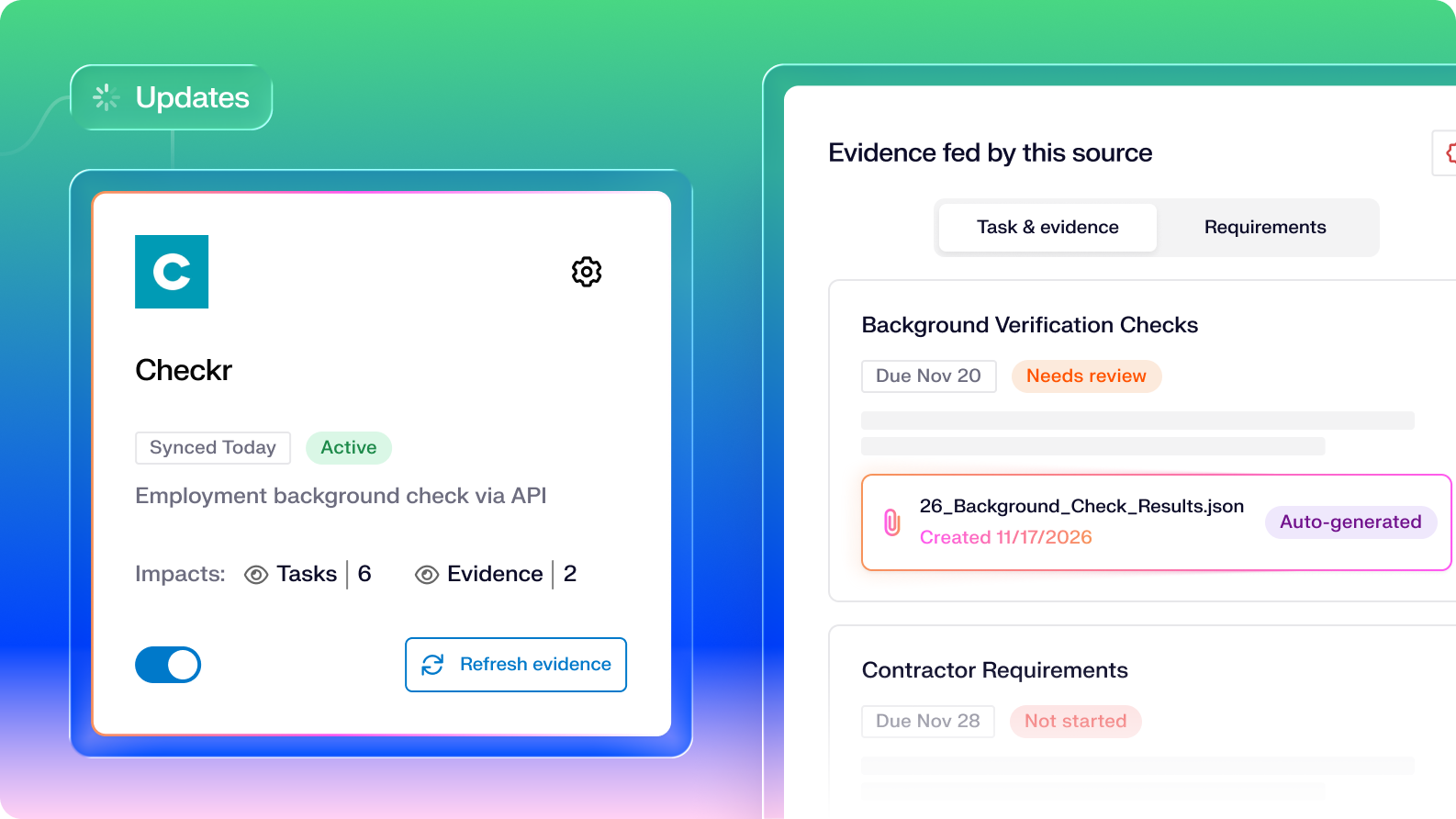
Automate evidence collection
Automatically pull evidence from connected sources via Iru Compliance AutomationShare your maturity posture externally
Leverage a public-facing portal to share your posture with customers via Iru Trust CenterControl which applications can run
Enforce approved application sets across your fleet via Iru Endpoint Management — Application controlPatch applications and operating systems
Continuously detect and remediate application, OS and firmware risk via Iru Vulnerability Management — Patch applications, Patch operating systemsHarden user applications
Reduce the attack surface in browsers and user software via Iru Endpoint Management — User application hardeningManage Microsoft Office macro settings
Enforce macro policy across managed devices via Iru Endpoint Management — Configure Microsoft Office macro settingsRestrict administrative privileges
Separate administrative accounts and remove standing admin rights via Iru Workforce Identity — Restrict administrative privilegesRequire multi-factor authentication
Enforce phishing-resistant, device-bound authentication via Iru Workforce Identity — Multi-factor authenticationEssential Eight: Prove your maturity level, not just your intentions
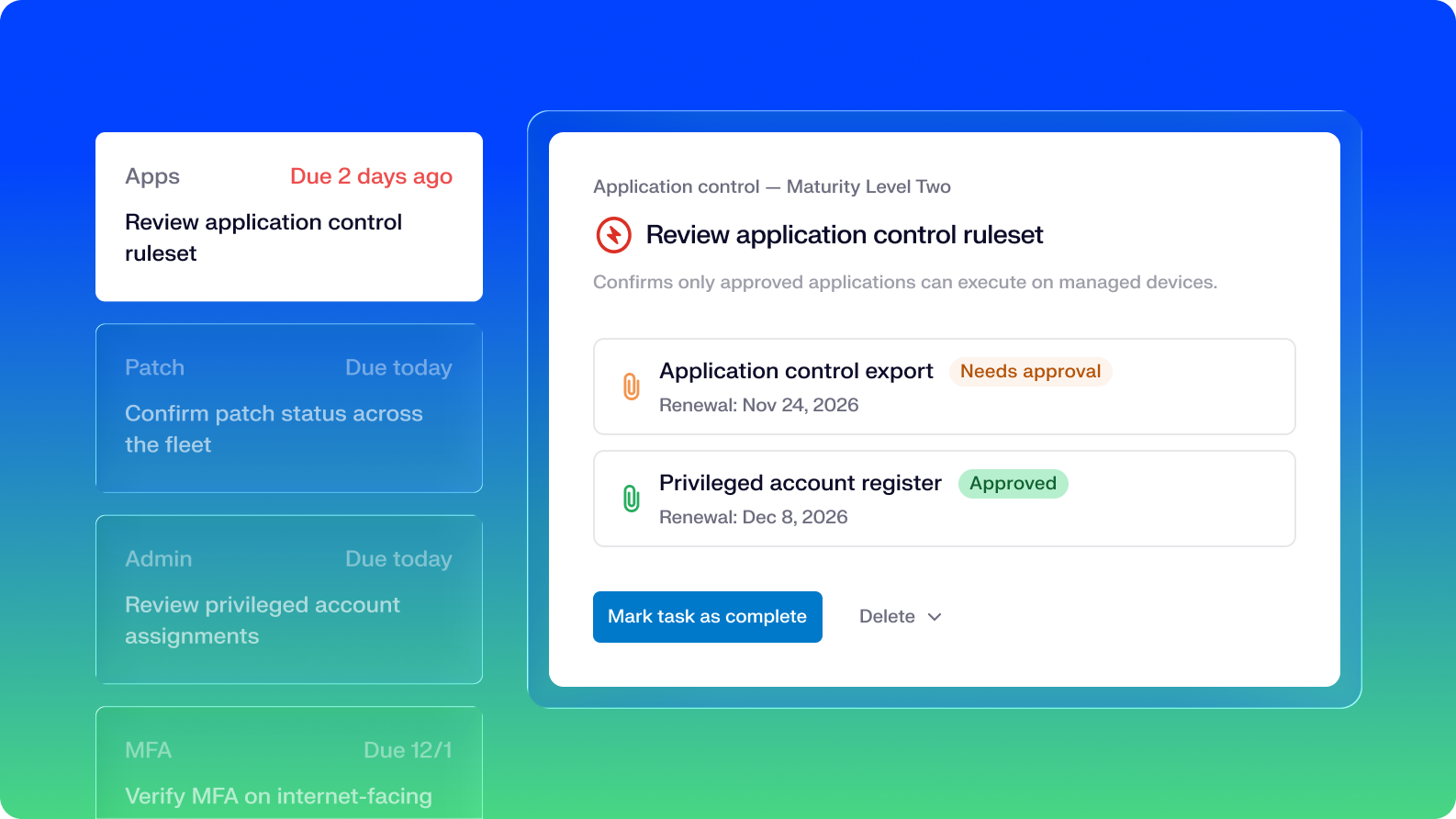
Iru combines native endpoint and identity telemetry with continuous evidence collection, making it easier to implement seven of the eight mitigation strategies and evidence the maturity level you've actually reached.
Customise Essential Eight controls for your unique business
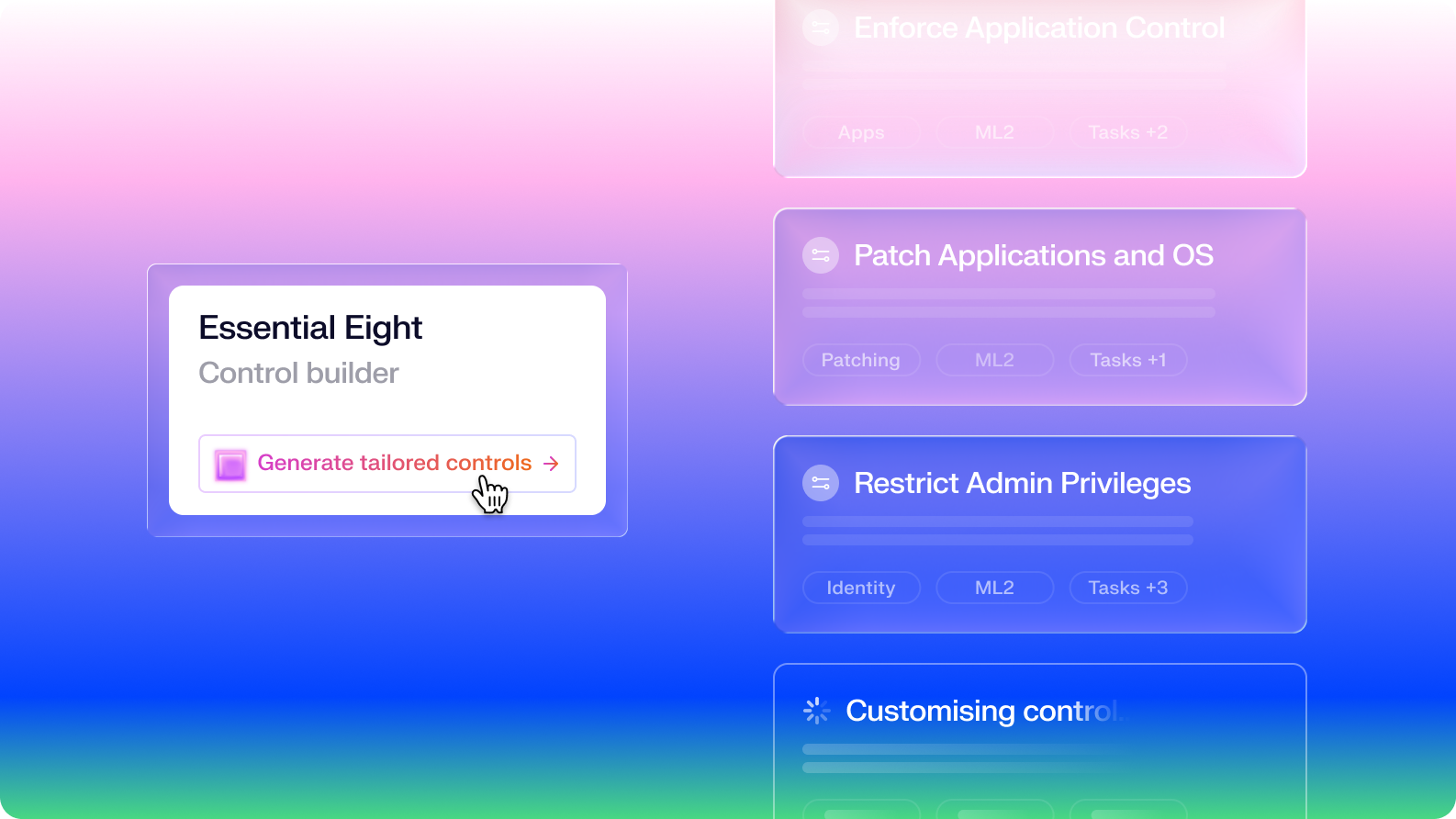
Most compliance tools turn frameworks into generic checklists. Iru generates controls that are specific to your organisation, in plain language, broken down into sub-tasks.
- Iru AI generates tailored controls, based on your company context and audit details
- You can migrate existing controls over from other products, or upload your own custom control set
- Controls become actions the moment they are created, with suggested owners and due dates

Automate your Essential Eight evidence collection
For connected and activated sources, Iru can discover and attach relevant artifacts to the supported control actions, reducing manual uploads. And because you can manage your devices and identity within Iru, that data is pulled natively.
- Evidence flows in continuously from supported devices, integrations and systems
- Iru AI helps to identify stale, missing or potentially irrelevant evidence for you to review
- You stay better prepared before fieldwork begins, with fewer fire drills before your engagement

Ensure continuous Essential Eight audit readiness
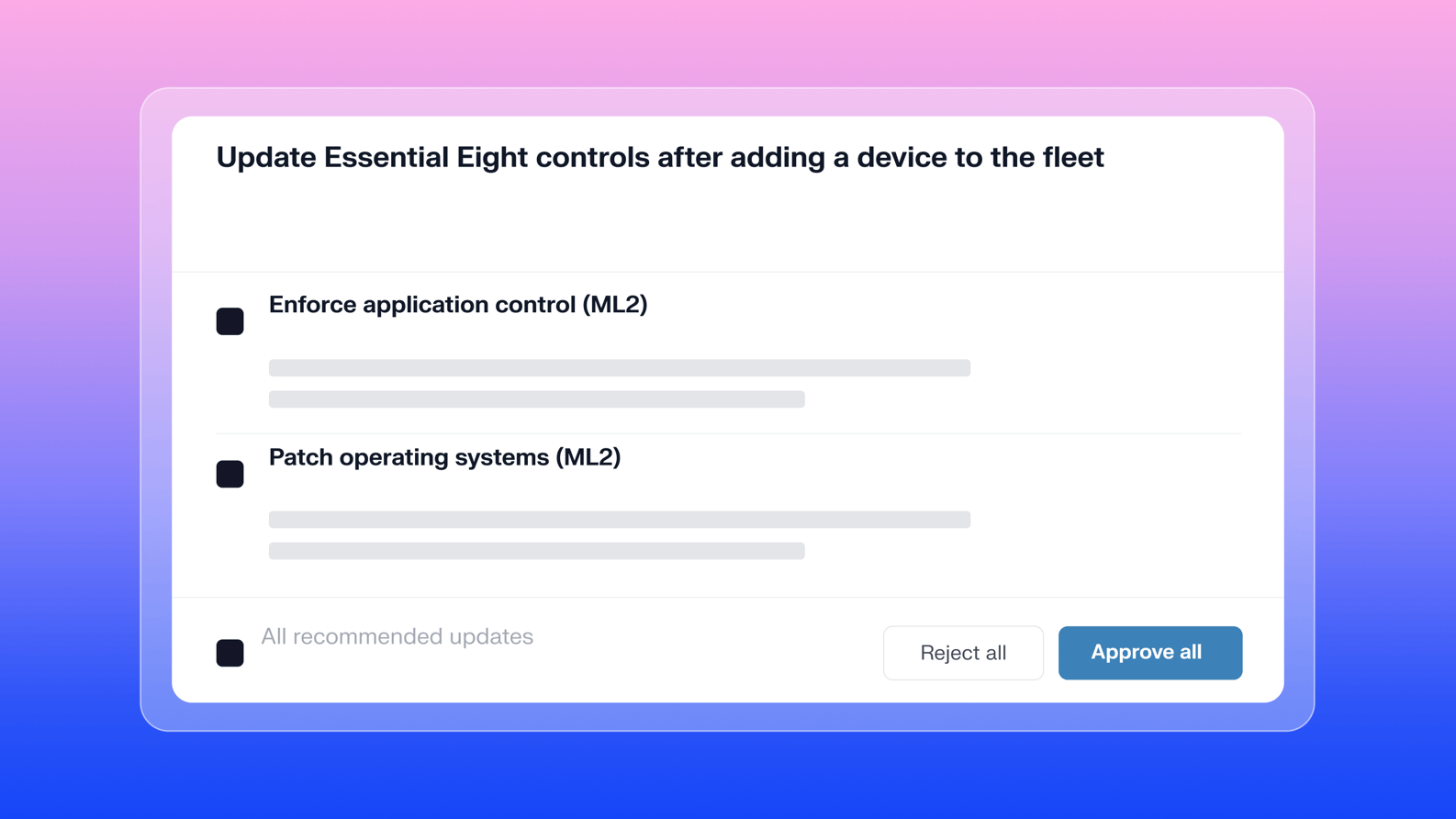
Iru's Adaptive Compliance capabilities watch for changes in your organisation, and automatically suggest updates to your controls and actions.
- Iru AI regularly checks for changes to your sources, artifacts or company profile
- If a change is detected, a control update recommendation is surfaced for you to review, often within 24 hours
- No changes are made without your approval, and every change is logged for your auditors to review

Turn Essential Eight preparation into an always-on workflow
Iru's AI-powered compliance solution helps IT, security and GRC teams spend less time on manual compliance work and stay audit-ready all year.
Let your team focus on what matters
Iru replaces fragmented tools with one AI-powered platform, so IT & security spend less time chasing tickets and more time improving the business.
Frequently asked
questions
Get answers to commonly asked questions
Who publishes and maintains the Essential Eight?
The Australian Signals Directorate (ASD), through its Australian Cyber Security Centre. ASD first published the Essential Eight Maturity Model in June 2017 and updates it periodically — the most recent substantial revision was November 2023.
The Essential Eight sits within ASD's broader Strategies to Mitigate Cyber Security Incidents, and ASD also publishes a mapping between the Maturity Model and the Information Security Manual.
What are the eight strategies?
The eight strategies defined by this framework are:
- Application control — only approved applications can execute
- Patch applications — apply vendor patches for application vulnerabilities
- Configure Microsoft Office macro settings — block macros that aren't needed
- User application hardening — reduce the attack surface in browsers and other user software
- Restrict administrative privileges — limit who holds admin rights, and how they're used
- Patch operating systems — apply vendor patches for OS vulnerabilities
- Multi-factor authentication — verify users with more than a password
- Regular backups — maintain and test backups you can actually restore from
What are the maturity levels?
There are four maturity levels, from Maturity Level Zero to Maturity Level Three. Zero means significant weaknesses. One, Two and Three describe increasingly complete implementation, calibrated against adversaries of increasing capability.
The important part is how they interact. ASD's guidance is to reach the same level across all eight strategies before moving up. Being at Level Three on patching while sitting at Level One on application control doesn't make you a Level Three organisation — it makes you a Level One organisation with strong patching.
Does our maturity level expire?
ASD expects organisations to be assessed against the current version of the model. Thusly, maturity is not a thing you achieve once, because a model revision can move your rating without you changing anything.
Is the Essential Eight mandatory?
For non-corporate Commonwealth entities, yes. Under PSPF Policy 10, they've been required since 1 July 2022 to implement all eight strategies to Maturity Level Two, and to consider whether their threat environment warrants Maturity Level Three.
For everyone else it's voluntary — but increasingly it's a commercial requirement. If you sell to government, or into a supply chain that does, expect to be asked what maturity level you're at.
Where a strategy can't be fully implemented, compensating controls may be used to manage the residual risk, provided they give equivalent protection to the requirement they're standing in for.
Can we get "Essential Eight certified"?
No. ASD doesn't run a certification scheme for the Essential Eight, and nobody can issue you a certificate for it.
What exists is assessment. ASD publishes guidance on how Essential Eight assessments should be conducted, and the output is a maturity level rating rather than a credential. Assessments can be run internally or by a third party.
If a supplier tells you they're "Essential Eight certified", ask which maturity level, assessed by whom, against which version of the model, and when.
What maturity level should we target?
Maturity Level Two is the practical answer for most organisations. It's what PSPF Policy 10 requires of non-corporate Commonwealth entities, which makes it the de facto benchmark in Australian procurement even for organisations the PSPF doesn't reach.
Maturity Level Three is for organisations whose threat environment warrants it — ASD asks Commonwealth entities to consider whether theirs does.
Set the target across all eight strategies at once rather than optimising the ones that are easy.
How does the Essential Eight relate to ISO 27001 or SOC 2?
They answer different questions. The Essential Eight is a prescriptive set of eight technical mitigations with defined maturity levels. ISO 27001 and SOC 2 assess whether you run a management system or meet control criteria — broader in scope, far less specific about what you actually deploy.
They overlap heavily in evidence. Patching, MFA, admin privilege restriction and application control all appear in each. What the Essential Eight gives you that the others don't is a number a buyer immediately understands.
Can Iru get us to Maturity Level Two?
Iru supports seven of the eight strategies directly. The exception is regular backups — Iru has no backup product, and you'll need a separate solution for that strategy.
That distinction matters more here than it would elsewhere. Because ASD's guidance is to reach the same maturity level across all eight, your backup posture will cap your overall rating regardless of how strong the other seven are.
For those seven it takes the platform rather than the compliance product alone. Iru Endpoint Management handles application control, user application hardening, macro configuration and operating system patching. Iru Vulnerability Management covers application patching. Iru Workforce Identity handles multi-factor authentication and administrative privilege restriction. Iru Compliance Automation collects the evidence continuously, so your maturity assessment reflects current state rather than a point in time.