 Workforce Identity
 Endpoint Management
 Endpoint Detection & Response
 Vulnerability Management
 Compliance Automation
 Trust Center




Cybersecurity has become one of the defining business risks of the modern era. In a recent U.S. Chamber of Commerce survey, 60% of small businesses said cybersecurity threats are a top concern, ranking above theft, natural disasters, and terrorism.
A cybersecurity risk assessment gives organizations a practical way to understand where they're most vulnerable and which problems to address first, while supporting major frameworks such as the NIST Cybersecurity Framework and ISO/IEC 27001. This guide breaks down the process into clear, actionable steps businesses can start using today.
What is a cybersecurity risk assessment?
A cybersecurity risk assessment is a structured way to find, weigh, and rank the threats to digital assets like data, networks, and computer systems. Its purpose is to help an organization understand where risk exists, how serious it is, and what actions will reduce exposure most effectively.
At its core, a risk assessment helps teams decide which threats matter most and where to act first. It evaluates how security incidents could impact business objectives and reputation, mapping technical exposure to operational risks that technical staff and business leaders can act on.
The risk assessment process typically includes three core components:
- Risk identification: Catalog digital assets, systems, processes, and threat vectors that could lead to security incidents or operational disruption.
- Risk analysis: Evaluate how likely each risk is to lead to an actual security incident and the severity of its potential financial, operational, and reputational impact.
- Risk treatment: Decide how to address each risk, based on business priorities. Typically, risk treatments fall into one of four categories: avoidance, mitigation, transfer, or acceptance.
A cybersecurity risk assessment broadly assesses organizational exposure, while a vulnerability assessment focuses more narrowly on identifying technical weaknesses, such as unpatched software or misconfigurations. Vulnerability scanning is often done as part of a larger risk assessment.
Why risk assessments matter
Cybersecurity risk assessments help organizations move from reactive incident response to proactive risk management. Instead of waiting for a breach or other security incident to spur action, teams can identify likely threats early and reduce exposure before security gaps lead to business disruptions.
That shift toward proactivity is more important than ever as computing environments grow more complex. Computers, smartphones, and tablets now operate within broad ecosystems that include SaaS applications and cloud infrastructure, expanding exposure risks and creating clear business and compliance reasons for regular security risk assessments.
- Compliance: Frameworks and regulations, including SOC 2, ISO 27001, HIPAA, PCI DSS, NIST 800-53, CMMC, and GDPR, all require organizations to conduct and document comprehensive risk assessments of ongoing governance and audit readiness.
- Resource prioritization: AI and automation in cybersecurity are reshaping enterprise risk faster than teams can adapt. With more than 90% of business leaders citing AI skill gaps, and many expecting those gaps to persist, structured risk assessments are essential when security resources are limited.
- Executive visibility: Risk assessments translate technical findings into business language that leadership can evaluate and act on. That alignment improves decision-making across the organization.
- Supply chain risk: Modern cyber attacks increasingly target software vendors and integrations rather than the enterprise directly. For example, Cyble found that software supply chain attacks rose 93% from 2024 to 2025, highlighting third-party trust relationships as a growing primary attack vector.
- Reduced breach costs: The financial stakes are high: the global average cost of a data breach reached $4.44 million in 2025, while organizations with strong AI-driven security and automation saved nearly $1.9 million per breach through faster detection and containment.
Regular security assessments do more than reduce exposure: they help organizations understand where risk exists, how it affects operations, and what to address first. To do that consistently, teams need a structured framework for identifying, evaluating, and prioritizing cybersecurity risk.
Cybersecurity risk assessment frameworks
No single cybersecurity assessment framework fits every organization. The right choice depends on the industry and associated regulatory requirements, as well as the operating complexity and security maturity of the organization. Some frameworks provide broad strategic guidance, while others offer prescriptive controls for measuring and managing risk.
SOC 2
Developed by the American Institute of Certified Public Accountants, SOC 2 is a voluntary compliance framework commonly used by SaaS providers and service organizations. It’s an “examination engagement” issued by an independent CPA firm (commonly called an audit) about their controls.
ISO/IEC 27001, 27701, and 42001
Published by the International Organization for Standardization and the International Electrotechnical Commission, these standards are widely used by multinational organizations and in heavily regulated industries.
Here’s a breakdown of a few of the most important ISO standards:
- ISO/IEC 27001 defines requirements for an information security management system.
- ISO/IEC 27701 builds on ISO 27001 to define Privacy Information Management Systems (PIMS).
- ISO/IEC 42001 focuses specifically on improving Artificial Intelligence Management Systems (AIMS).
An MDM solution like Iru can help your organization achieve compliance with these frameworks while improving your overall security posture.
HIPAA
A U.S. federal regulation (Health Insurance Portability and Accountability Act) enforced by the Office for Civil Rights (OCR). Organizations must produce internal documentation, such as risk analyses, policies, and procedures, to remain compliant with the rule.
GDPR
A legal compliance obligation for any organization that works with the personal data of European Union (EU) and European Economic Area (EEA) citizens. Organizations comply with the GDPR by providing Records of Processing Activities (ROPA) and Data Protection Impact Assessments (DPIA), where applicable.
NIST CSF
Developed by the National Institute of Standards and Technology (NIST), the Cybersecurity Framework (CSF) is the most widely adopted U.S. cybersecurity framework. It organizes security efforts into six functions: Govern, Identify, Protect, Detect, Respond, and Recover.
Iru supports three different forms of NIST 800:
- NIST 800-53:A U.S. federal security controls catalog mandated for federal agencies under FISMA.
The other two forms are part of the CMMC, seen below.
CMMC 2.0
A U.S Department of Defense (DoD) cybersecurity certification program studied through three different levels:
- Level 1: Requires a self-assessment to ensure organizations follow 17 different practices.
- Level 2:Requires third-party assessment to follow 110 best practices per NIST 800-171.
- Level 3:Requires government-led assessment following standards established in NIST 800-172.
Book an Iru demo today to see compliance automation in action.
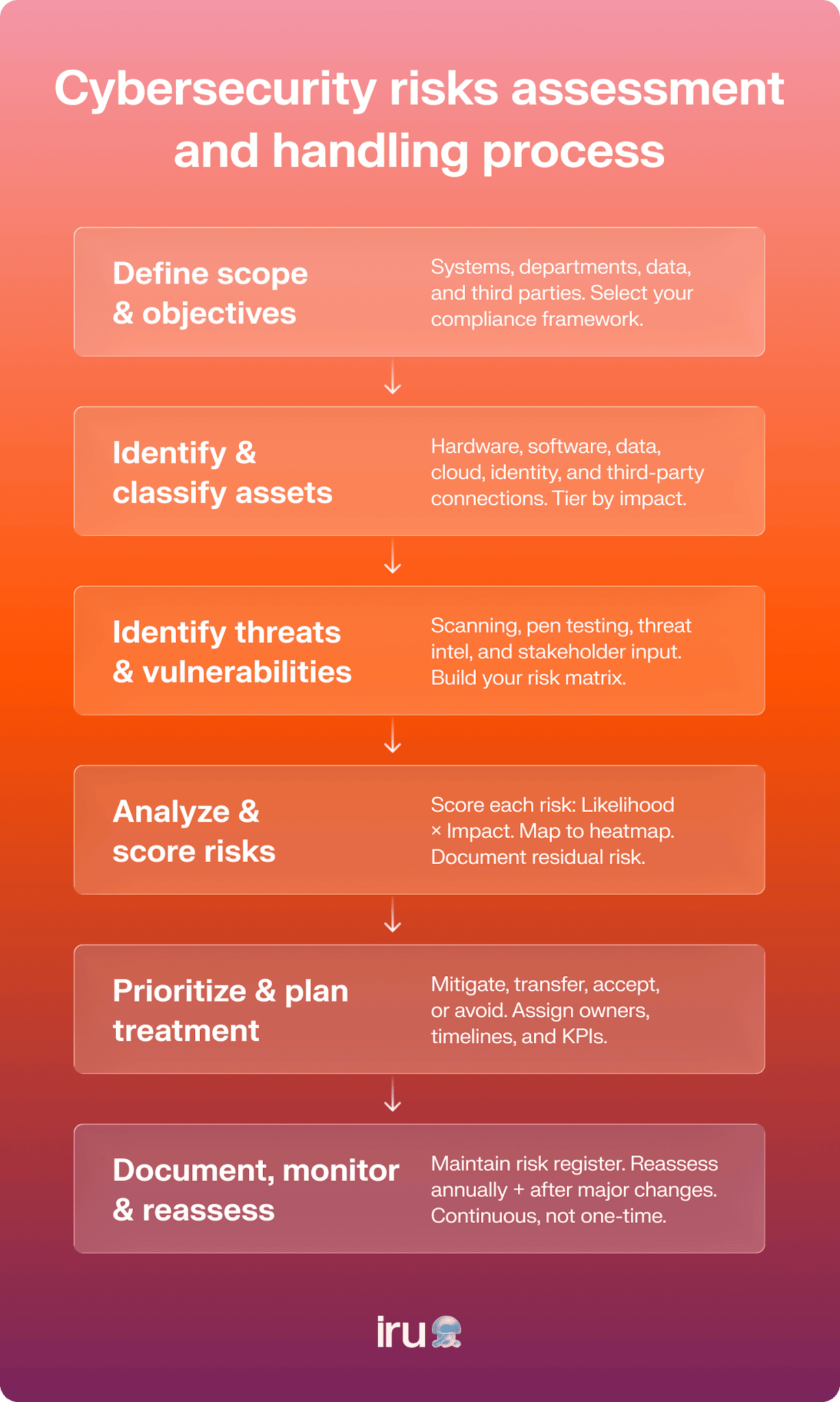
How to conduct a cybersecurity risk assessment: 6 steps
Cybersecurity risk assessment should be a continuous process, not a one-time project. As systems change and new threats emerge, organizations need a repeatable process for identifying and reducing risk over time, using tools like Iru to help simplify visibility, monitoring, and compliance reporting.
Step 1: Define scope and objectives
Start by clearly defining what the assessment will cover and what it needs to accomplish. Effective risk assessments follow a simple high-level path: identify, evaluate, and prioritize vulnerabilities. This clear workflow allows teams to focus resources where they will be most effective in reducing overall risk.
The scope of a cyber risk assessment typically includes:
- Systems: Endpoints, servers, applications, networks, and cloud services.
- Departments: Business units with unique operational or compliance requirements.
- Data: Sensitive, regulated, or business-critical information assets.
- Third parties: Vendors, software providers, and external service partners.
Objectives of the risk assessment should be clearly defined, driven by compliance, incident response, business continuity, and broader security planning. At this stage, framework selection is critical, since it shapes how risk is measured, prioritized, mitigated, and aligned with required compliance standards.
Step 2: Identify and classify assets
Once the scope is defined, organizations need a complete inventory of the assets used to store, process, or access business information. Those assets should then be classified by type, business value, and sensitivity so IT teams can focus security resources on the systems and data that carry the most risk.
- Data: Sensitive information like personally identifiable information (PII) and financial records should be classified by sensitivity to prioritize appropriate security controls and monitoring.
- Hardware/endpoints: Managed and unmanaged devices like computers and mobile, whether owned by users or the organization, introduce risk and need to be accounted for.
- Cloud/SaaS: SaaS apps, cloud workloads, and containers expand the attack surface and should be tracked alongside on-premises systems for consistent security oversight.
- Identity: User accounts, service accounts, and API keys should be tracked and mapped to system access to help manage privileges and reduce security risk.
- Personnel & third parties: Employees, contractors, vendors, and partners with system access should be evaluated and restricted using least privilege, with ongoing monitoring and regular access reviews.
- Network infrastructure: Firewalls, switches, routers, and VPN gateways are often overlooked in inventories, creating blind spots that attackers can use to move undetected across systems.
- IoT and OT devices: Printers, smart building systems, and operational technology often run outdated firmware and lack monitoring, making them overlooked attack points.
Once assets are identified, sorting them into priority tiers helps focus IT resources on areas where disruption or compromise would have the greatest business impact. A simple ranking model can facilitate faster, more consistent risk-based decision-making.
- 0 = Essential: Critical servers, production databases, and core network infrastructure required for daily operations and business continuity.
- 1 = Important: Development environments, internal business tools, and backup systems that support operations but are not immediately mission-critical.
- 2 = Not essential: Workstations, peripherals, and non-sensitive devices that typically carry lower operational and compliance risk.
Step 3: Identify threats and vulnerabilities
With assets classified, the next step is identifying how they could be compromised and where weaknesses already exist by mapping threats to technical, policy, and operational gaps. Organizations use tools like vulnerability scanners, SIEMs, threat intelligence, endpoint platforms, and Iru to build a complete risk picture and automate data collection.
- Threat intelligence: Industry reports (like Iru's quarterly threat reports) and security updates help organizations understand emerging threats and what attackers are actively targeting.
- Vulnerability scanning: Automated tools find outdated software, missing patches, and insecure settings across systems so teams can fix issues before attackers exploit them.
- Penetration testing: Simulated attacks help uncover security gaps that automated tools may miss, including ways attackers could gain higher access within systems (like Dock Tile plugins on Mac).
- Historical incident data: Past breaches, near misses, and audit issues help identify patterns and focus resources on the most likely real-world threats.
- Existing security policies: Access rules, passwords, device controls, and response plans should be reviewed regularly, as weak policies can create risk even when technical defenses are strong.
- Stakeholder interviews: Input from IT, security, and business teams helps uncover real-world risks that tools alone may not detect.
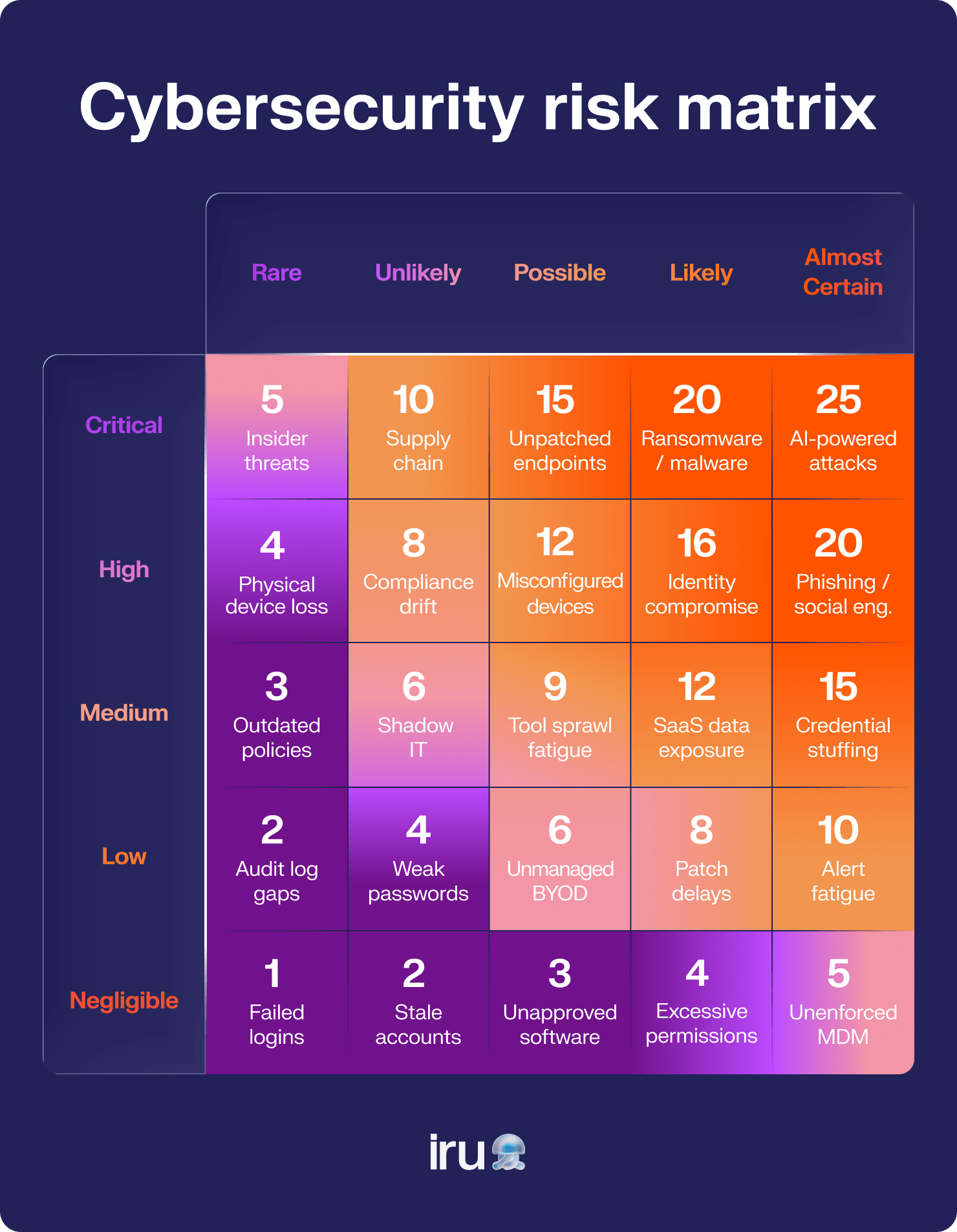
This threat and vulnerability data can be organized into a threat assessment matrix to help teams evaluate the likelihood and business impact of each type of risk.
Step 4: Analyze and score risks
With threats and vulnerabilities identified, the next step is measuring risk in a consistent, repeatable way. A threat assessment matrix allows organizations to score each threat-asset pair, compare risks objectively, and prioritize security efforts based on the likely business impact for each.
For each threat-asset pair, assign a likelihood score, from 1 (rare) to 5 (almost certain), based on threat intelligence, known vulnerabilities, and historical incident data. Then assign an impact score reflecting potential financial loss, operational disruption, compliance violations, and reputational damage, ranging from 1 (negligible) to 5 (catastrophic).
Multiply Likelihood × Impact to generate a risk score for each pair, then map the scores onto a heatmap-style grid to visualize priority levels. Organizations should document both inherent risk (before controls) and residual risk (after controls), possibly using frameworks like FAIR to support executive-level reporting in financial terms.
Step 5: Prioritize and plan treatment
Organizations can use the cybersecurity risk assessment matrix to prioritize risks with the highest scores and decide how to treat each one. This ensures that security resources are focused on the highest-likelihood, highest-impact risks first instead of trying to spread effort across all risk-asset pairs.
- Mitigate: Implement technical or procedural controls to reduce the likelihood or impact of the risk. Examples include patching, segmentation, and access restrictions.
- Transfer: Shift risk to a third party through mechanisms like cyber insurance or outsourcing functions like Security Operations Center (SOC) monitoring.
- Accept: Formally acknowledge the risk when the cost to mitigate it outweighs its potential impact, and choose to take no action. Document with executive sign-off.
- Avoid: Eliminate the risk entirely by discontinuing the vulnerable system, process, or activity.
A structured treatment plan should define owners, timelines, and success metrics (KPIs – Key Performance Indicators) for each risk. The goal is not just risk reduction, but a shared understanding of the adopted security posture among all stakeholders so that execution is measurable and unimpeded by red tape.
Step 6: Document, monitor, and reassess
Cybersecurity risk assessment is an ongoing discipline, not a one-off project. Maintain a current risk register (a catalog of organizational risk factors), continuously monitor key risk indicators, and provide regular reporting to leadership so priorities, progress, and emerging threats remain visible across the organization.
Organizations should formally reassess risk at least once a year, and also following major infrastructure changes or new deployments. Significant security events may require even more rigorous assessment or third-party risk assessment. Continuous review keeps risk management aligned with evolving threats, business operations, and compliance requirements.
Best practices for cybersecurity risk assessments
Effective cybersecurity risk assessments are structured and repeatable, tied to both business outcomes and technical findings. The strongest programs combine input from across the organization with continuous visibility and automation to position assessment as an ongoing business operation.
- Start with business context: Assess risk in relation to business objectives and organizational risk tolerance. Security programs are most effective when they prioritize protecting what matters most to the business.
- Involve cross-functional stakeholders: Cyber risk management extends beyond security teams alone. Input from IT operations, legal, HR, finance, and business units helps identify risks that technical reviews and controls may miss.
- Automate evidence collection: Manual evidence gathering slows assessments and creates reporting bottlenecks. Continuous collection through integrated tools like Iru can reduce weeks of audit preparation to days, or even hours.
- Assess third parties: Vendor and supply chain risks are among the fastest-growing threat vectors. Regular third-party reviews and vendor risk assessments help identify weaknesses before they become entry points for attackers.
- Quantify for executives: Financial modeling frameworks like FAIR translate technical risk into business language that leadership can evaluate. That clarity helps justify investments and supports informed decision-making.
- Make it continuous: Annual assessments should be the baseline, not the end goal. Continuous monitoring helps organizations identify emerging threats and new vulnerabilities as they appear.
- Map controls across frameworks: Many organizations operate under multiple frameworks simultaneously, from NIST and CIS to SOC 2, ISO, HIPAA, or PCI DSS. Mapping shared controls reduces duplicate work and simplifies compliance management. A unified compliance platform like Iru handles this automatically.
- Have the right software: The right platform brings endpoint management, identity security, and compliance automation into a unified operational view. Iru helps organizations centralize visibility, automate control mapping, and streamline risk management.
Common mistakes made during cybersecurity risk assessments
A cybersecurity risk assessment is only valuable if it leads to clear decisions and a measurable plan of action. Common mistakes can turn the process into nothing more than a compliance exercise that leaves critical risks unaddressed despite significant time and effort spent.
- Checkbox exercise: Some organizations conduct assessments simply to satisfy audit or regulatory requirements. Without meaningful analysis of real-world threats and business impact, assessments may improve compliance on paper while risk remains unchanged.
- Boiling the ocean: Trying to assess every asset and potential threat at once often leads to complexity and stalled progress. Start with critical assets and high-impact risks, then expand assessment coverage over time.
- Ignoring endpoint risk: Laptops, desktops, smartphones, and tablets remain some of the most common attack entry points. Organizations that focus only on network or cloud security often overlook critical user endpoints where incidents frequently begin.
- Skipping the asset inventory: Shadow IT, unmanaged devices, and undocumented services often go uncataloged and create hidden risk exposure that remains outside formal security controls and threat analysis.
- Failing to quantify: Generic labels like “high” or “medium” provide limited decision-making value without some business context. Risk scoring should reflect operational and financial impacts of potential security issues, using a quantitative model like FAIR, to support effective prioritization.
- No follow-through: Assessment findings need assigned owners, remediation timelines, and measurable outcomes. Without accountability and execution, information security risk assessments aren't much more than documentation exercises.
- Ignoring identity risk: Credential-based attacks are one of the most common initial access methods in cybersecurity incidents. Assessing identity controls like authentication, privilege management, and API credentials is essential for reducing exposure and limiting lateral movement if there is a compromise.
Streamline cybersecurity risk assessment with Iru
Cybersecurity risk assessments help IT teams identify, prioritize, and reduce threats across the organization, including Mac fleets managed through Mac MDM solutions. By aligning risk with business impact and compliance needs, teams shift from reactive fixes to proactive security.
Iru supports the full risk assessment workflow by automating evidence collection and helping you map controls across multiple security frameworks to standardize and operationalize the threat management process.
If you're ready to build out your cybersecurity risk assessment process, book a demo of Iru today.