
 Workforce Identity
 Endpoint Management
 Endpoint Detection & Response
 Vulnerability Management
 Compliance Automation
 Trust Center


Picture that you have a fleet of 1,500 people across four offices, maybe a mix of Macs, Windows, and mobile devices. You run SentinelOne for endpoint detection and response (EDR), but it sits apart from the tools you use to manage most devices.
SentinelOne earns credit for its automated responses to ransomware attacks. But some users feel like the console can feel dense at scale, and it takes tuning to keep active alerts clean. If you’ve experienced this firsthand and are looking for something a bit different, here are some SentinelOne alternatives that may better meet your needs.
At-a-glance: SentinelOne alternatives
| Software | Best for | G2 Rating |
|---|---|---|
| Iru | Unified EDR, identity, and compliance | 4.7/5 |
| CrowdStrike Falcon | Enterprise-level EDR/XDR | 4.6/5 |
| Microsoft Defender for Endpoint | Windows-first environments | 4.4/5 |
| Palo Alto Cortex XDR | Cross-domain XDR correlation | 4.5/5 |
| Trend Vision One | XDR breadth across email, network, and cloud | 4.7/5 |
| Bitdefender GravityZone | Prevention-first EPP + EDR | 4.7/5 |
| Huntress Managed EDR | Lean teams and MSPs | 4.9/5 |
| Cybereason | Grouping telemetry into attack stories | 4.4/5 |
1. Iru
- Best for: Unified EDR, identity, and compliance
- G2 Rating: 4.7/5
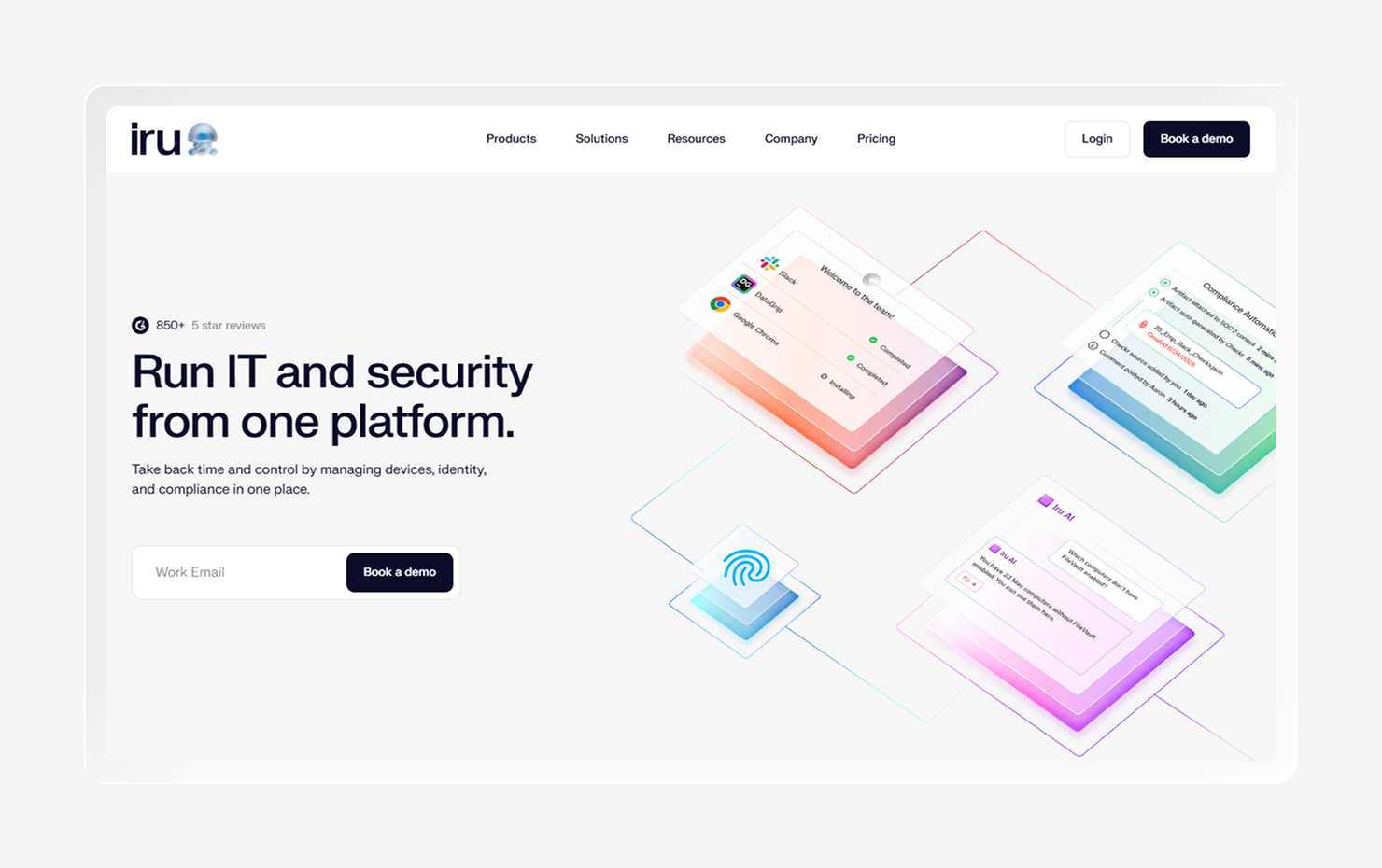
Iru, formerly Kandji, runs EDR on the same agent that handles your device management, vulnerability management, and identity. It gives IT and security teams one view of every user and device, making it a lightweight, simple endpoint visibility and control platform to SentinelOne.
Iru AI unites specialized agents across identity & access, endpoint security & management, and compliance automation, delivering insights, actions, and evidence from a single interface.
Behind the product, an in-house research team continuously refines detections from Iru’s own telemetry and publishes new threat intelligence. Its threat intelligence has also been tested by third parties, as a 2025 Miercom EDR competitive assessment found that Iru earned top marks for macOS malware detection, alerting, and reporting.
Customers also appreciate how easy the platform is to use:
“Compared to other MDM tools, [Iru] truly differentiates itself through continuous improvements, fast feature releases, and industry-leading innovation. Integrations like Single Sign-On with Okta, Automated Device Enrollment (ADE), and their new Threat Protection module have transformed how we manage security across our devices.”
For teams juggling separate tools for security and device management, that consolidation is the real draw. You get EDR, identity, and compliance from a single agent and console.
Key features
- Behavioral and file detection: Iru AI monitors system events in real time to detect both known malware and suspicious behavior, logging each as a structured event record.
- Device isolation: Cut a compromised device off the network with one click to contain a threat while you investigate.
- Storage controls: Lock down removable media, such as USB drives and SD cards, to close a common data exfiltration path.
- MCP server integration: Run detection and response workflows through conversational prompts using the Model Context Protocol (MCP).
- Amazon S3 integration: Stream EDR telemetry and event logs automatically to your own Amazon S3 storage for retention and analysis.
2. CrowdStrike Falcon
- Best for: Enterprise-level EDR/XDR
- G2 Rating: 4.6/5
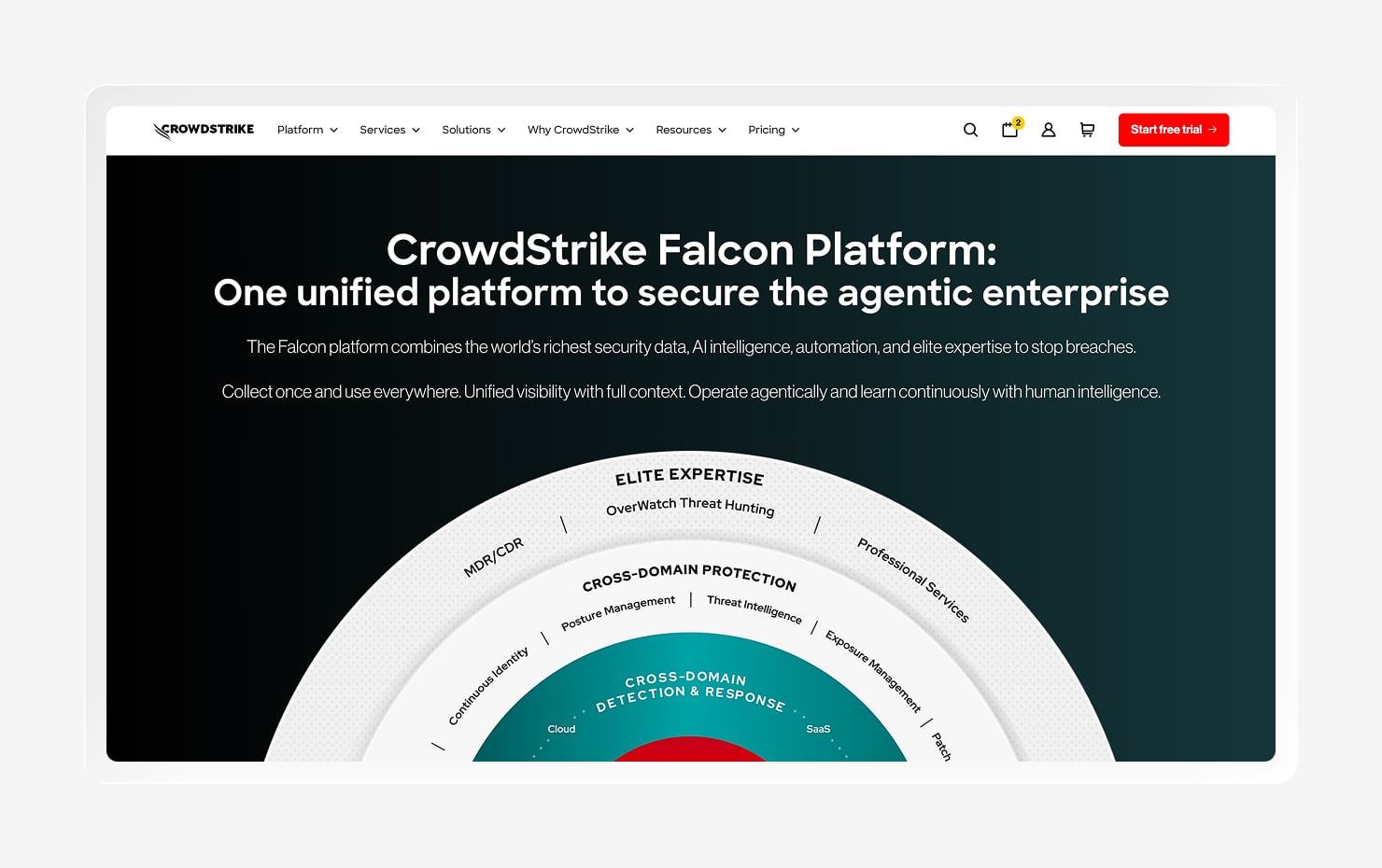
Unlike Iru’s consolidated agent, CrowdStrike Falcon focuses squarely on cloud-native endpoint protection and EDR. It runs on a single lightweight sensor that streams telemetry to the cloud, where Threat Graph correlates signals across CrowdStrike’s global install base to spot patterns a single environment might miss.
Falcon is modular, meaning you start with endpoint protection and add optional capabilities such as identity protection, threat intelligence, and exposure management as needed. For hands-on coverage, the OverWatch team runs continuous human-led threat hunting, and Falcon Complete delivers fully managed detection and response.
Falcon is a deep enterprise-grade platform. On G2, reviewers praise its fast detection and attack-chain context. But others call it out for its cost and complexity, as the console takes time to master.
Key features
- Falcon Insight XDR (Extended Detection and Response): Extends endpoint detection across identity, cloud, and other sources for correlated, cross-domain investigation.
- Threat Graph: Correlates telemetry across CrowdStrike’s global customer base to surface threats faster.
- Attack mapping: Records what ran, what spawned it, and what it touched, reconstructing how incidents unfold.
- Automated remediation: Uses Real Time Response and Falcon Fusion orchestration to contain threats and automate response actions.
3. Microsoft Defender for Endpoint
- Best for: Windows-first environments
- G2 Rating: 4.4/5
If your team runs mostly Windows, Microsoft Defender for Endpoint is the natural pick as an enterprise EDR platform. Despite its Windows focus, it manages threats across macOS, Linux, iOS, and Android from the Microsoft Defender portal, integrating directly with other Microsoft products such as 365, Entra ID, and Sentinel to support conditional access and identity.
The endpoint monitoring platform comes in two plans. Plan one focuses on prevention, antivirus, device control, and attack surface reduction. Plan 2 adds EDR, automated investigation and remediation, vulnerability management, and access to Microsoft Threat Experts. This is included with Microsoft 365 E5, making it an ideal choice for organizations that already rely on Microsoft’s 365 products.
But despite it working across multiple operating systems, Defender for Endpoint is strongest inside the Microsoft ecosystem. Reviewers also note that it takes some work to configure and tune, especially if working outside a pure Windows environment.
Key features
- Endpoint detection and response: Detects attacks in real time and lets you respond directly on the device, with six months of data for investigation.
- Attack surface reduction: Enforces rules that close off common attack paths at the operating-system level, from risky macros to untrusted executables.
- Automated investigation and remediation: Inspects alerts and automatically resolves common threats to reduce analyst workload.
- Vulnerability management: Surfaces and prioritizes device vulnerabilities and misconfigurations so you can harden endpoints.
4. Palo Alto Cortex XDR

- Best for: Cross-domain XDR correlation
- G2 Rating: 4.5/5
For teams that already run Palo Alto firewalls, Cortex XDR is a natural extension connecting endpoint, network, cloud, and identity data into a single detection engine. It then uses those connections and applies behavioral analytics to catch attacks that move across those vectors.
When Cortex XDR flags a threat, it reconstructs the full attack narrative from how it got in to which assets were affected. It then groups related alerts into single incidents to reduce noise. Analysts can then use this information to isolate devices, terminate processes, or run automated playbooks through Palo Alto XSOAR to remediate issues.
Overall, Cortex XDR is a strong fit for security operations teams that want cross-domain visibility, especially if they already manage the company’s firewalls. However, some customers feel that the volume of data is too high, burying the signal that helps teams find quick solutions.
Key features
- Cross-domain correlation: Natively unifies endpoint, network, cloud, and identity data to detect attacks that span multiple vectors.
- Behavioral analytics and root cause: Profiles user and system behavior to spot anomalies, then reconstructs the full attack chain.
- Endpoint prevention: Blocks malware, exploits, and fileless attacks through a lightweight agent with AI-driven local analysis
- Automated response: Isolates devices, terminates processes, and runs a playbook through XSOAR to contain threats quickly.
5. Trend Vision One
- Best for: XDR breadth across email, network, and cloud
- G2 Rating: 4.7/5
Trend Vision One correlates activity across email, the network, and the cloud alongside endpoint data, pulling telemetry from a wide range of native sensors for its detection and response workflow. That reach makes it incredibly useful for hybrid infrastructures that want threat detection across multiple layers.
When it detects a threat, Vision One isolates affected endpoints and automatically terminates malicious processes. It then correlates that detection with signals from other layers to help IT get the full picture. Teams that get the most out of this platform likely already have some cross-platform visibility through other tools.
The platform’s breadth presents a learning curve for some teams, though. You get full value only after you connect its various sensors and data sources and tune the correlation rules so that results stay actionable rather than noisy.
Key features
- Cross-layer XDR: Correlates endpoint, email, network, and cloud telemetry through native sensors for detection that spans the whole environment.
- Cyber Risk Exposure Management (CREM): Discovers assets and scores exposure based on asset criticality and business impact to support vulnerability prioritization.
- AI Companion: A generative-AI assistant that guides investigations, suggests next steps, and builds automations to cut manual work.
- Network Detection and Response (NDR): Converts network activity into telemetry and correlates it with endpoint, cloud, and email signals to surface lateral movement.
6. Bitdefender GravityZone
- Best for: Prevention-first Endpoint Protection Platform (EPP) + EDR
- G2 Rating: 4.1/5
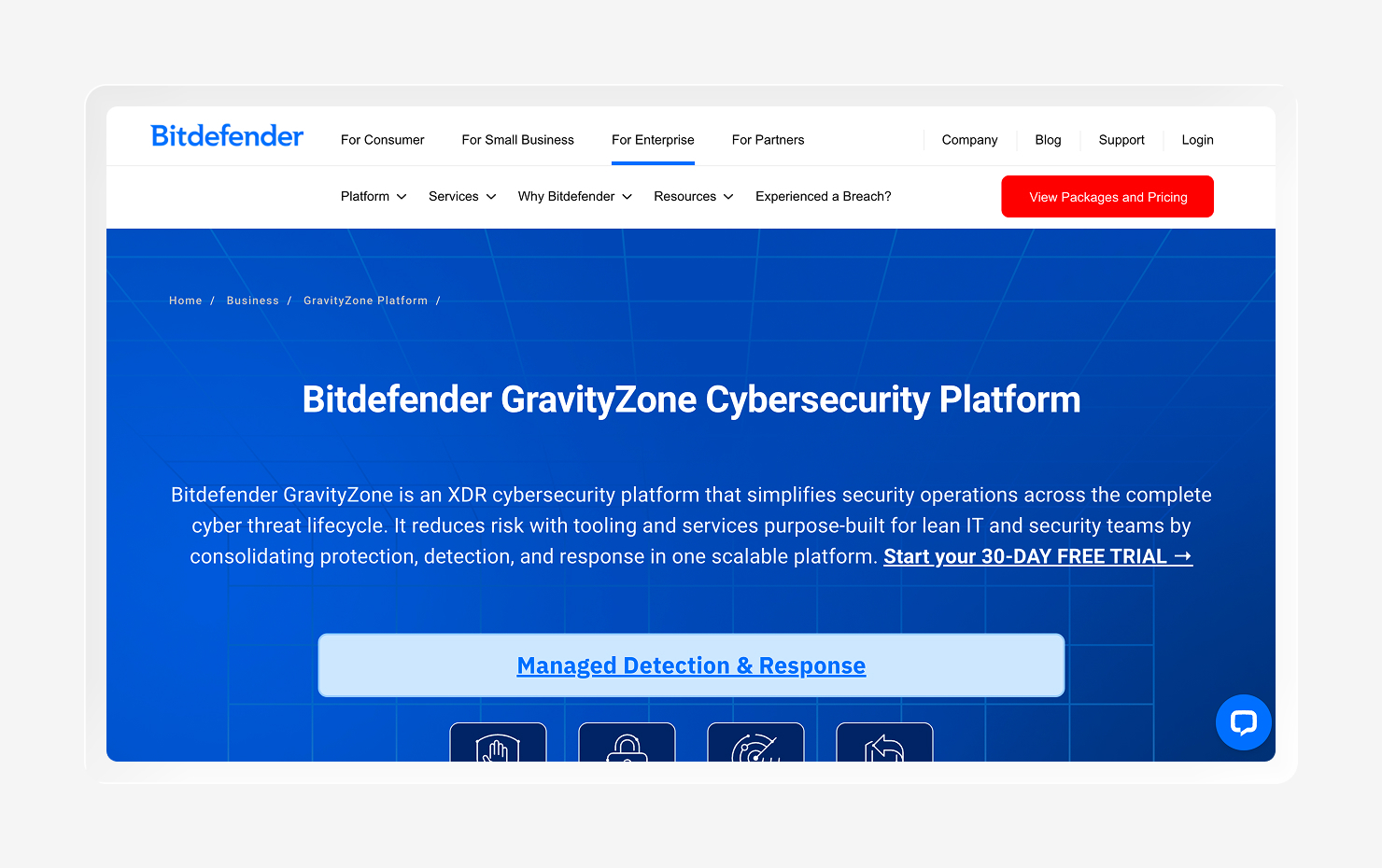
Bitdefender GravityZone stacks over 30 machine-learning and behavioral detection layers to stop malware, exploits, and fileless attacks before they execute. It’s known for high ratings on AV-TEST and MITRE, so it’s a solid fit for those who prioritize stopping ransomware and advanced malware.
Through an EDR layer, GravityZone correlates attack indicators across endpoints and network traffic into unified incidents. This helps build the attack chain and recommends response actions, so that smaller teams can more easily understand and contain threats without having to tune the software. The platform also scores exposures across users, devices, and apps through its Risk Analytics feature.
GravityZone is a solid fit for those who prioritize budget-friendly, prevention-focused security. However, it might not offer the same depth of EDR and XDR as some enterprise-level platforms.
Key features
- Multi-layered prevention: More than 30 security layers, including HyperDetect and Fileless Attack Defense, that stop threats before they hit.
- Ransomware mitigation: Detects abnormal encryption in real time, blocks the process, and restores affected files.
- Endpoint risk management: Identifies vulnerabilities, misconfigurations, and risky user behavior and mitigates them from a single console.
- Patch management: Keeps operating systems and third-party apps current across Windows, macOS, and Linux from a single console.
7. Huntress Managed EDR
- Best for: Lean teams and MSPs
- G2 Rating: 4.9/5
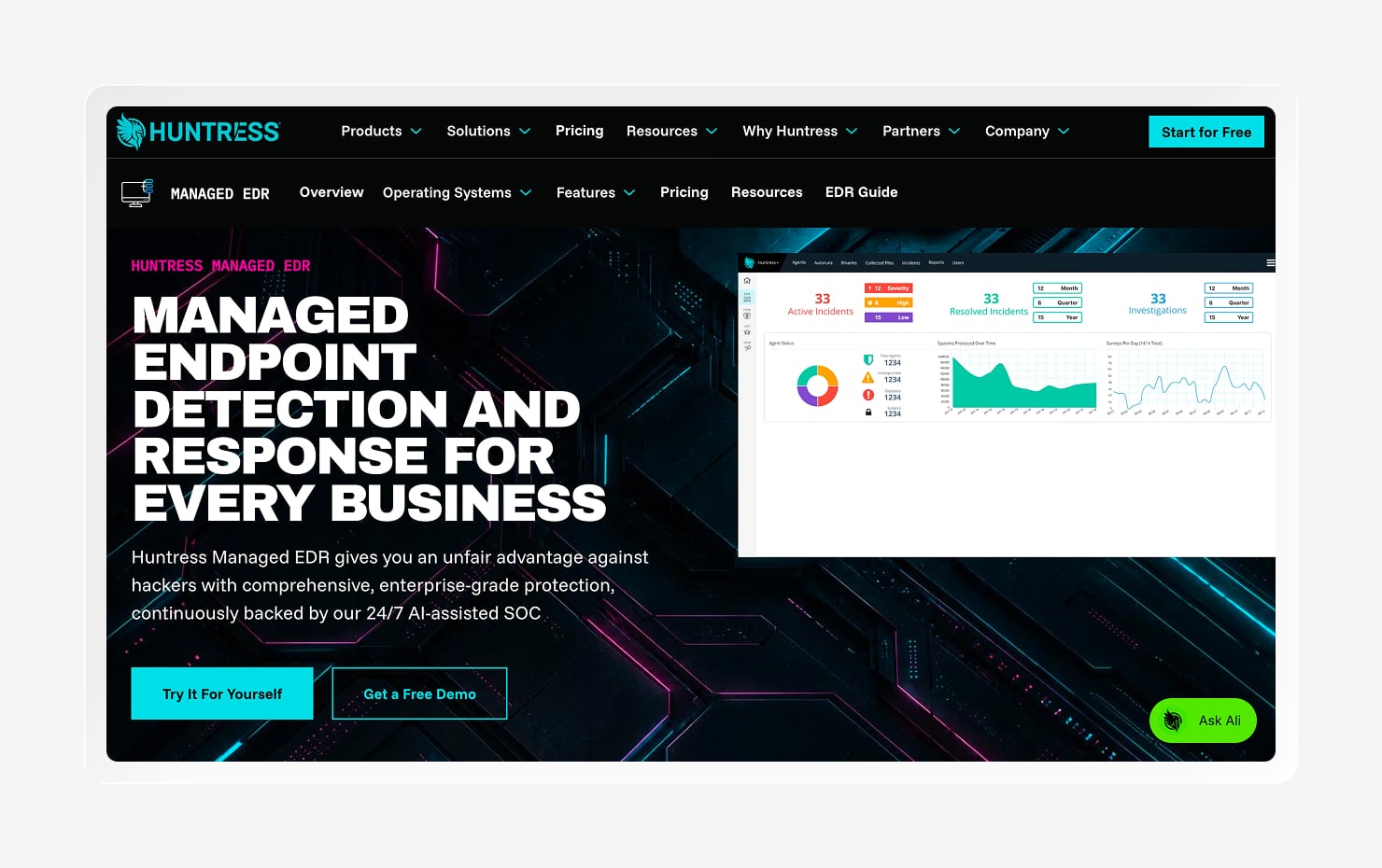
Huntress Managed EDR is a good pick for lean teams because it provides a 24/7 security operations center (SOC) that watches your endpoints and handles investigations for you. With a human-led model, lean teams aren’t left deciding what to do next; instead, they can leave it to a team of professionals.
Coverage also extends beyond endpoints to Microsoft 365 identities, catching account takeovers and business email compromises to protect identity as well as endpoints. This makes it great for smaller organizations that are looking for a bit more protection, but it’s less of a fit for teams that want more control and deeper customization.
Key features
- Human-led SOC: A 24/7 security operations center investigates and validates every detection, so your team acts on real threats.
- Real-time attack disruption: Automatically disrupts active endpoint attacks, containing them before they spread.
- Endpoint attack visibility: Surfaces persistent footholds and malicious activity that antivirus software tends to miss, with clear incident reports.
- Automated remediation: Handles containment and remediation with SOC-backed action and step-by-step guidance through to resolution.
8. Cybereason
- Best for: Grouping telemetry into attack stories
- G2 Rating: 4.4/5
Cybereason correlates related activity across endpoints, identities, cloud, and network into one attack story through its MalOp (Malicious Operation) engine. This helps teams identify the root cause and spread of an attack through a single view rather than a scatter of disconnected detections.
The platform’s behavioral analytics system surfaces subtle indicators of compromise and behavior. That way, analysts can turn a pile of alerts into actionable context, making Cybereason a useful tool for investigating attacks.
Despite the usefulness of Cybereason’s research tools, some teams may find that there’s a learning curve before they get full value from the platform. It’s also more limited than many of the full device management tools on this list.
Key features
- MalOp engine: Correlates related activities across multiple layers into a single attack story.
- Behavioral analytics: Analyzes events in real time to flag indicators of compromise and subtle indicators of risky behavior.
- Attack storyline: Reconstructs the root cause, scope, and spread of an incident in a single view, so analysts can see the full sequence.
- Autonomous response: Runs one-click and automated actions like isolation, termination, and persistence removal from a single console.
How to choose the right SentinelOne alternative
The best fit depends on your fleet, your team, and how much of your security and device management you want running from one place. Weigh these factors as you compare:
- Platform coverage: Match the tool to the operating systems you actually run. Some go deep on Windows; others cover macOS, Linux, and mobile evenly.
- Managed vs self-run: Decide whether you have the staff to run detection yourself or want a managed service to handle monitoring and response for you.
- Detection and response model: Look at how each platform detects threats and how much it automates response, from autonomous containment to human-led guidance.
- Consolidation: Consider how many separate tools you’re stitching together. A platform like Iru unifies EDR, device management, identity, and compliance to cut tool sprawl.
- Stack integration: Check how cleanly each option integrates with the identity, security, and IT tools you already use, since that can determine how much manual work remains on your plate.
- Total cost: Factor in licensing, add-on modules, and staff time to run the platform you choose, not just the per-endpoint price.
Choose Iru for unified endpoint detection and response
The strongest SentinelOne alternatives all detect threats well, so the real question is how well they pull together around that detection. If your security tools are separate from the systems that manage your devices, consolidating them can save you hours of data collection.
That’s where Iru’s unified endpoint detection and response stands apart, running EDR on the same agent as device management, identity, and compliance. See what a single unified platform looks like in your environment.
Book a demo to learn how Iru can help you manage and secure your devices.