

Automate CMMC readiness with adaptive compliance
For contractors in the defense supply chain, CMMC — the Cybersecurity Maturity Model Certification program — is how your security gets verified. See how growing teams keep assessment evidence current rather than assembling it under deadline.

Unified by design. Built for the AI era.
Iru AI is designed from the ground up to connect a grid of agents behind the scenes—across identity, endpoint, and compliance. Powered by the Iru Context Model, it understands your users, apps, and devices to act safely, intelligently, and in context across your organization.
Implement the requirements, don't just describe them
Automate evidence collection
Automatically pull evidence from connected sources via Iru Compliance AutomationAnswer prime contractor questionnaires
Share your security posture through a public-facing portal via Iru Trust CenterControl access to CUI
Device-bound multi-factor authentication and separated admin accounts via Iru Workforce IdentityEncrypt CUI at rest
Apply full-disk encryption and maintain a live record of protected devices via Iru Endpoint ManagementMaintain secure configuration
Enforce secure baselines across your fleet via Iru Endpoint ManagementKeep software patched
Continuously detect and remediate OS and third-party software risk via Iru Vulnerability ManagementDetect and respond to incidents
Contain threats and document what happened via Iru Endpoint Detection & ResponseControl media and device disposal
Govern secure disposal and reuse of devices that held CUI via Iru Endpoint ManagementCMMC: Prove your implementation, not just your intent
Iru combines native endpoint and identity telemetry with continuous evidence collection, making it easier to implement the technical requirements behind your CMMC level and keep the evidence your assessment depends on.
Customize CMMC controls for your unique business
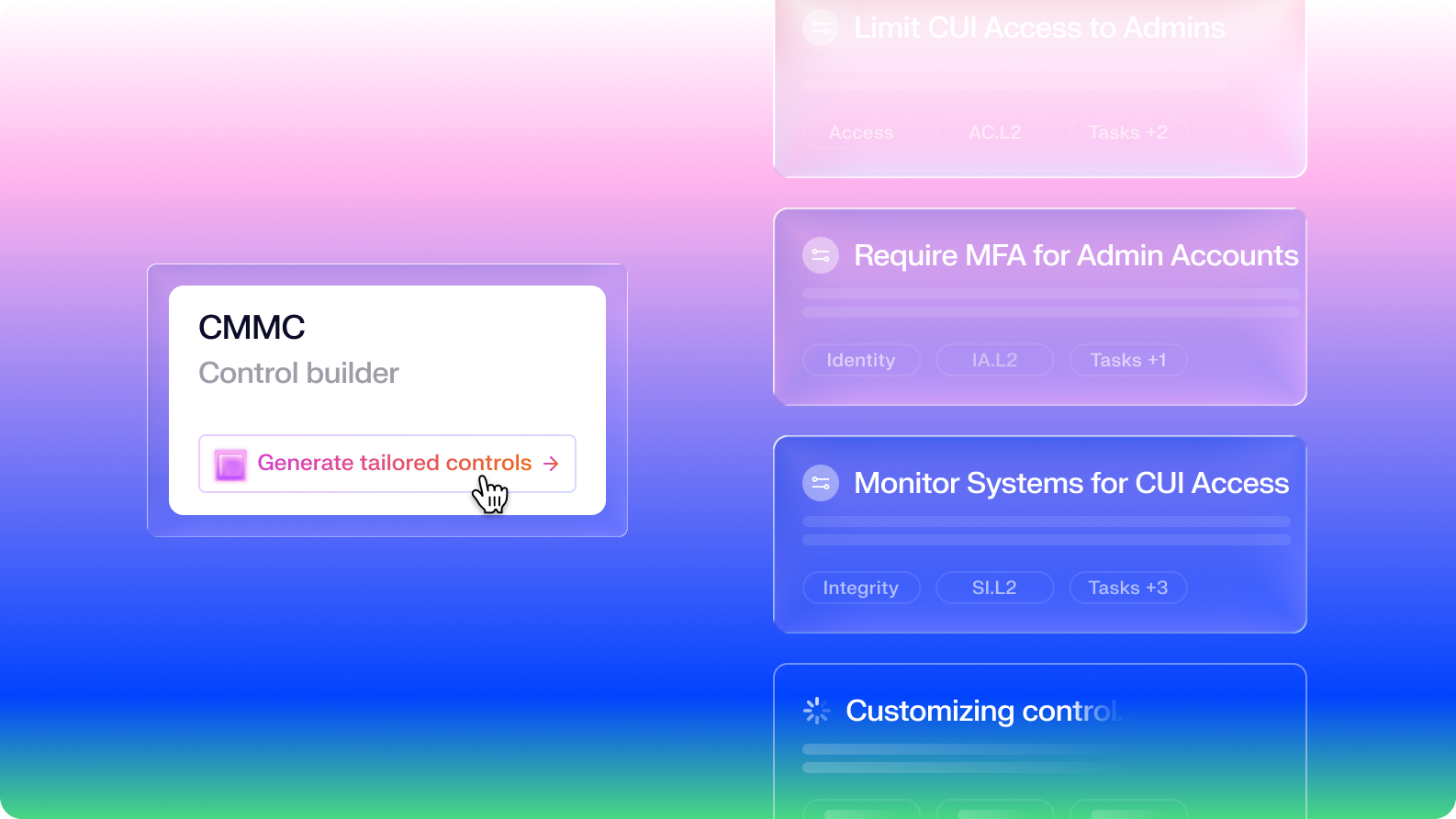
Most compliance tools turn frameworks into generic checklists. Iru generates controls that are specific to your organization, in plain language, broken down into sub-tasks.
- Iru AI generates tailored controls, based on your company context and audit details
- You can migrate existing controls over from other products, or upload your own custom control set
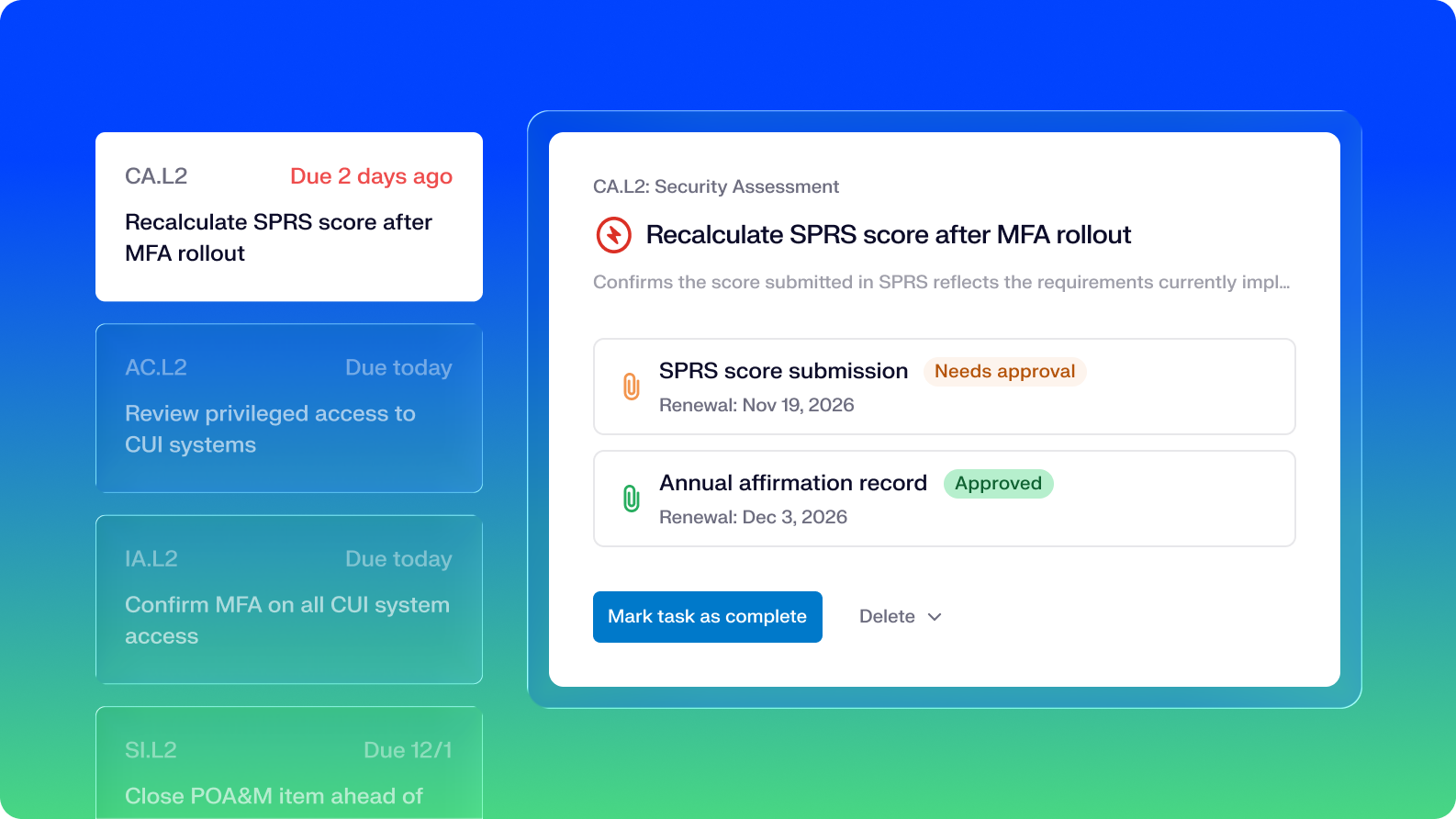
- Controls become actions the moment they are created, with suggested owners and due dates

Automate your CMMC evidence collection
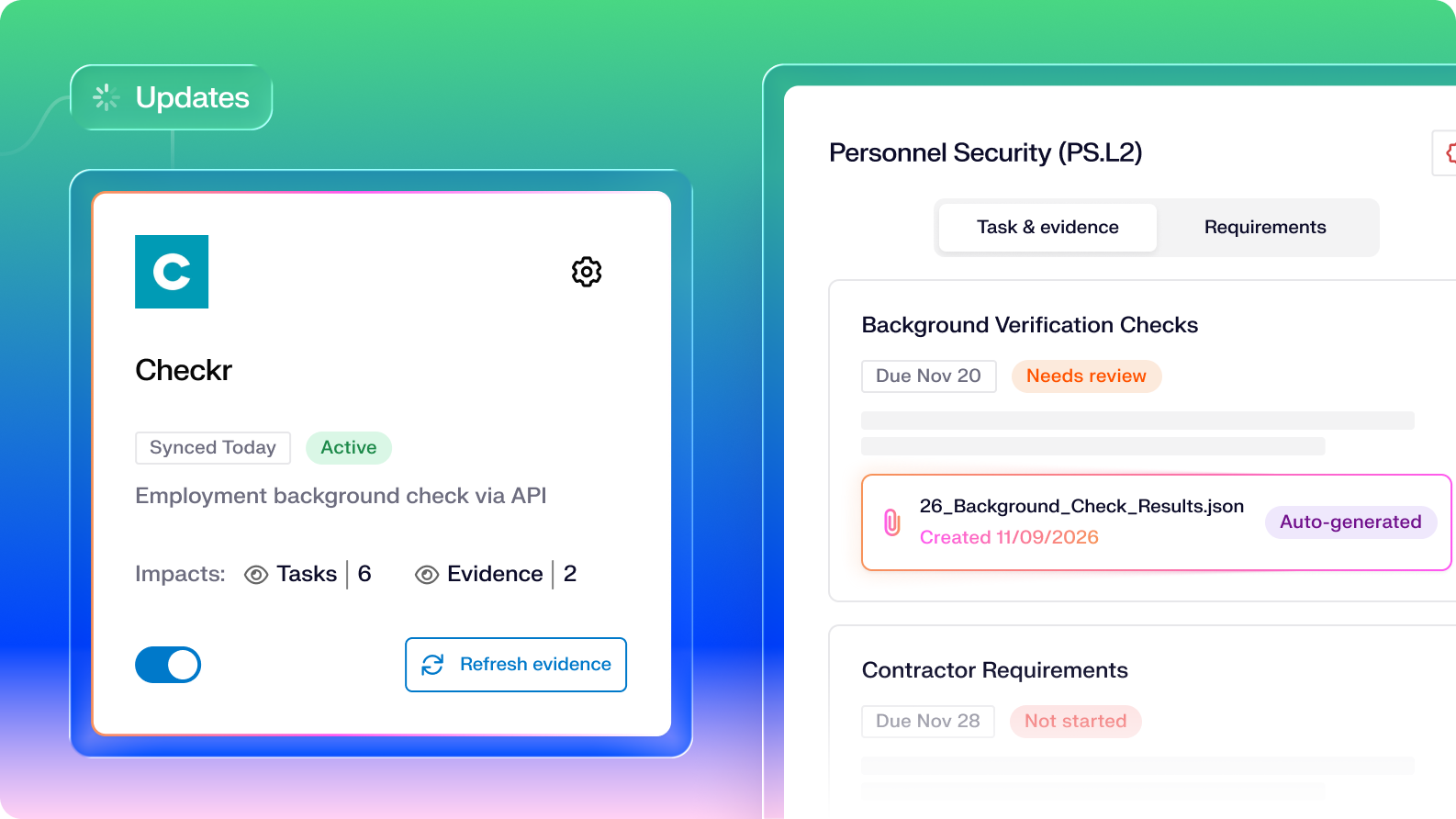
For connected and activated sources, Iru can discover and attach relevant artifacts to the supported control actions, reducing manual uploads. And because you can manage your devices and identity within Iru, that data is pulled natively.
- Evidence flows in continuously from supported devices, integrations and systems
- Iru AI helps to identify stale, missing or potentially irrelevant evidence for you to review
- You stay better prepared before fieldwork begins, with fewer fire drills before your engagement

Ensure continuous CMMC audit readiness
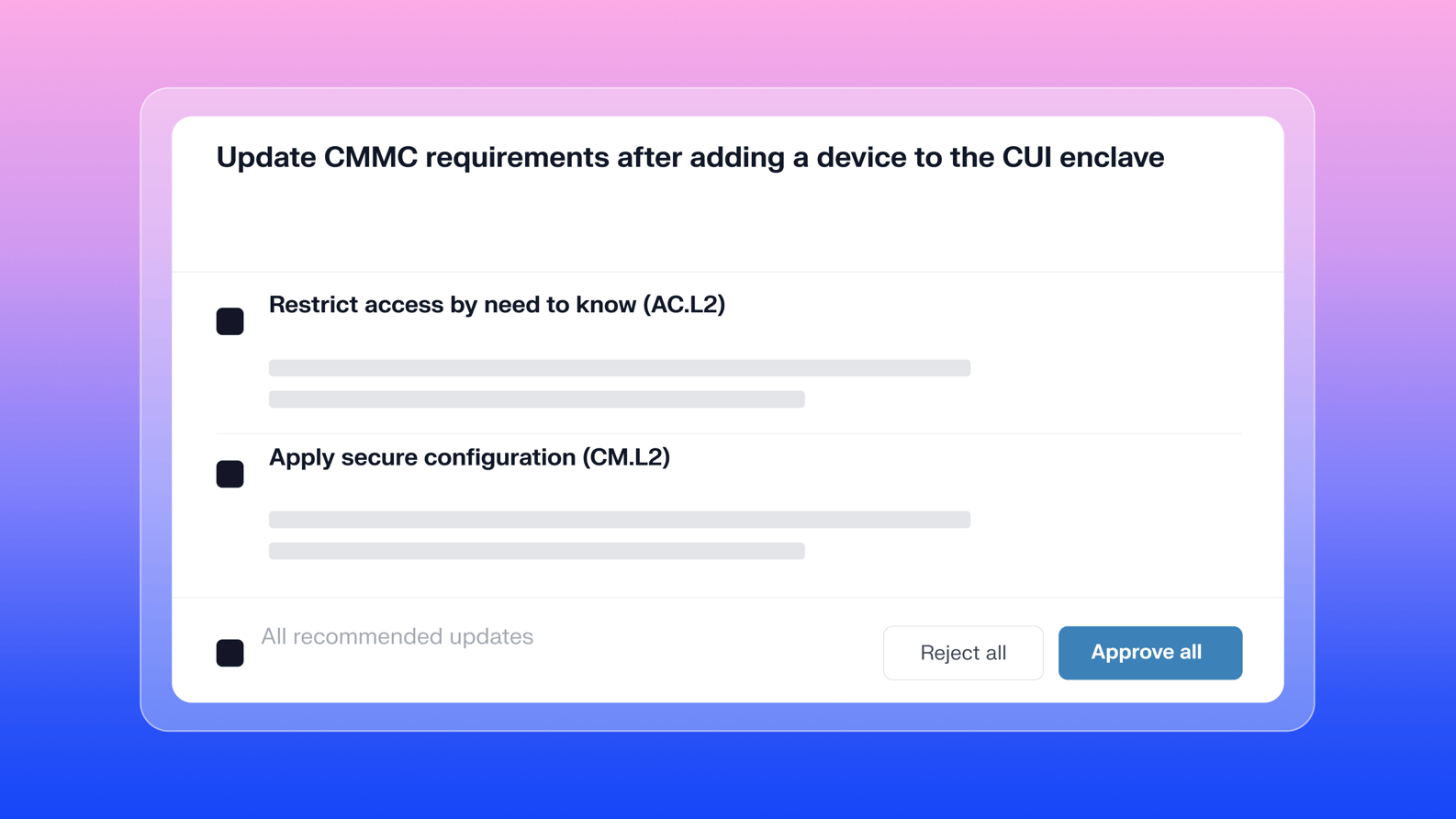
Iru's Adaptive Compliance capabilities watch for changes in your organization, and automatically suggest updates to your controls and actions.
- Iru AI regularly checks for changes to your sources, artifacts or company profile
- If a change is detected, a control update recommendation is surfaced for you to review, often within 24 hours
- No changes are made without your approval, and every change is logged for your auditors to review

Turn CMMC preparation into an always-on workflow
Iru's AI-powered compliance solution helps IT, security and GRC teams spend less time on manual compliance work and stay audit-ready all year.
Let your team focus on what matters
Iru replaces fragmented tools with one AI-powered platform, so IT & security spend less time chasing tickets and more time improving the business.
Frequently asked
questions
Get answers to commonly asked questions
What is CMMC, and who runs it?
CMMC is the Department of Defense’s (DoD’s) program for verifying that contractors have implemented required cybersecurity practices. It’s codified at 32 CFR Part 170.
It exists because self-attestation alone proved insufficient. CMMC introduces levels, defines who may assess, and sets what has to be submitted — turning "we’ve implemented it" into something checkable.
What’s the difference between CMMC and NIST 800-171?
NIST 800-171 sets the security requirements for protecting CUI (Controlled Unclassified Information). CMMC is the program that verifies you’ve met them — establishing levels, who can assess, and what gets submitted.
They aren’t interchangeable, and the levels aren’t simply 800-171 at increasing depth. Level 1 covers Federal Contract Information and isn’t 800-171 at all. Level 2 is where they align. Level 3 adds enhanced requirements.
And 800-171 reaches beyond defense — civilian agencies reference it on contracts where CMMC never applies.
What are the levels?
Level 1 — basic safeguarding of Federal Contract Information (FCI), drawing on FAR 52.204-21. This is a smaller set, and about FCI rather than CUI (Controlled Unclassified Information).
Level 2 closely mirrors the NIST 800-171 requirements. This is where most contractors who handle CUI land.
Level 3 — Level 2 plus enhanced requirements for the most sensitive work.
Which applies to your business is set by your contract, not by choice.
Where does CMMC stand right now?
Phase I is in force. Phase II is currently suspended.
Level 1 and Level 2 self-assessment requirements under Phase I remain current and valid. On 13 July 2026, the Department announced the immediate suspension of Phase II requirements, which had been scheduled to begin 10 November 2026. That suspension does not change Phase I obligations.
This is the most fluid part of the program. Confirm current status against the Department’s own pages before making commitments based on any published timeline. Meanwhile, Iru constantly monitors authoritative sources to reflect the updates that matter for your business within our Compliance Automation solution.
Which revision of 800-171 do CMMC assessments use?
Revision 2 — even though NIST (The National Institute of Standards and Technology) has withdrawn it.
NIST published Revision 3 and marked Revision 2 as withdrawn on its website. But CMMC assessments are conducted against Revision 2, under a class deviation memo, until that memo is withdrawn or superseded. You may implement Revision 3 voluntarily, but must use the Department’s Organization-Defined Parameters from the April 2025 memorandum.
Reading NIST’s site and concluding you should move to Rev 3 is a reasonable mistake with contractual consequences.
Do we need CMMC if we’re a subcontractor?
Usually yes, if you handle FCI or CUI. The requirement flows down through the supply chain, and your prime will need to demonstrate that it did.
Subcontractors are frequently where supply chain assessments find their gaps, which is why primes have moved from accepting assurances to asking for evidence.
Do we need CMMC if we don’t work with defense?
No. CMMC applies to the defense supply chain. If you have no federal or defense customers, it isn’t your framework — and neither is 800-171.
If you’re building a security program without a specific contractual driver, NIST CSF 2.0 is the more useful starting point.
What are SPRS and a POA&M?
SPRS — the Supplier Performance Risk System — is where your assessment results and your annual affirmation get submitted. It’s the system of record your prime contractor and the Department look at.
A POA&M — Plan of Action and Milestones — is a time-boxed plan to close a gap you haven’t closed yet. Whether you can use one depends on your level:
- Level 1 — never. Every requirement has to be met.
- Levels 2 and 3 — only if you score at least 88 out of 110, and only for the lowest-weighted requirements. You then have 180 days to close it.
The detail most teams miss: at Level 2 the assessment happens every three years, but the affirmation is annual. Two years out of three, that submission is the only thing standing between you and a lapse.
Can Iru get us CMMC certified?
No platform can. Your assessment is conducted by you or by an authorized third party depending on your level, and the outcome depends on your system boundary, your policies, your people and your evidence.
What Iru does is the technical requirements underneath, and it takes the platform rather than the compliance product alone. Iru Workforce Identity enforces access control and multi-factor authentication on the identities that reach CUI. Iru Endpoint Management maintains secure configuration and governs media and device disposal. Iru Vulnerability Management keeps software patched. Iru Endpoint Detection & Response detects and contains incidents. Iru Compliance Automation collects the evidence from all of them continuously, so your assessment reflects current state rather than a scramble before the deadline.
If you need an assessment, we can connect you with one of the assessors in our auditor network. Book a demo to explore the compliance solution, or if you’re already a customer, reach out to your rep for details on our audit partners.