 Workforce Identity
 Endpoint Management
 Endpoint Detection & Response
 Vulnerability Management
 Compliance Automation
 Trust Center





Vulnerability prioritization means assessing discovered vulnerabilities and deciding which ones pose the greatest risk to your environment. It’s like a mechanic deciding which problems to fix first. A scratched door can wait, but failing brakes can’t.
The number of new Common Vulnerabilities and Exposures (CVEs) keeps piling up. Far more can land in a day than your team can realistically investigate, let alone patch. Meanwhile, endpoint drift can quietly increase your exposure to vulnerabilities.
The hard part is figuring out which handful of vulnerabilities an attacker could exploit in your systems. Identify that and you’ll have won half the battle.
To help you out, we’ll break down how to separate the urgent risks from the noise. We’ll also cover vulnerability prioritization frameworks, what to look for when prioritizing vulnerabilities, and how Iru can help.
Is a CVSS score enough for vulnerability prioritization?
A Common Vulnerability Scoring System (CVSS) score can tell you how severe a vulnerability is from a technical standpoint. But severity only answers part of the question. The bigger challenge in vulnerability remediation is figuring out which vulnerabilities pose a real threat to your environment and deserve attention first.
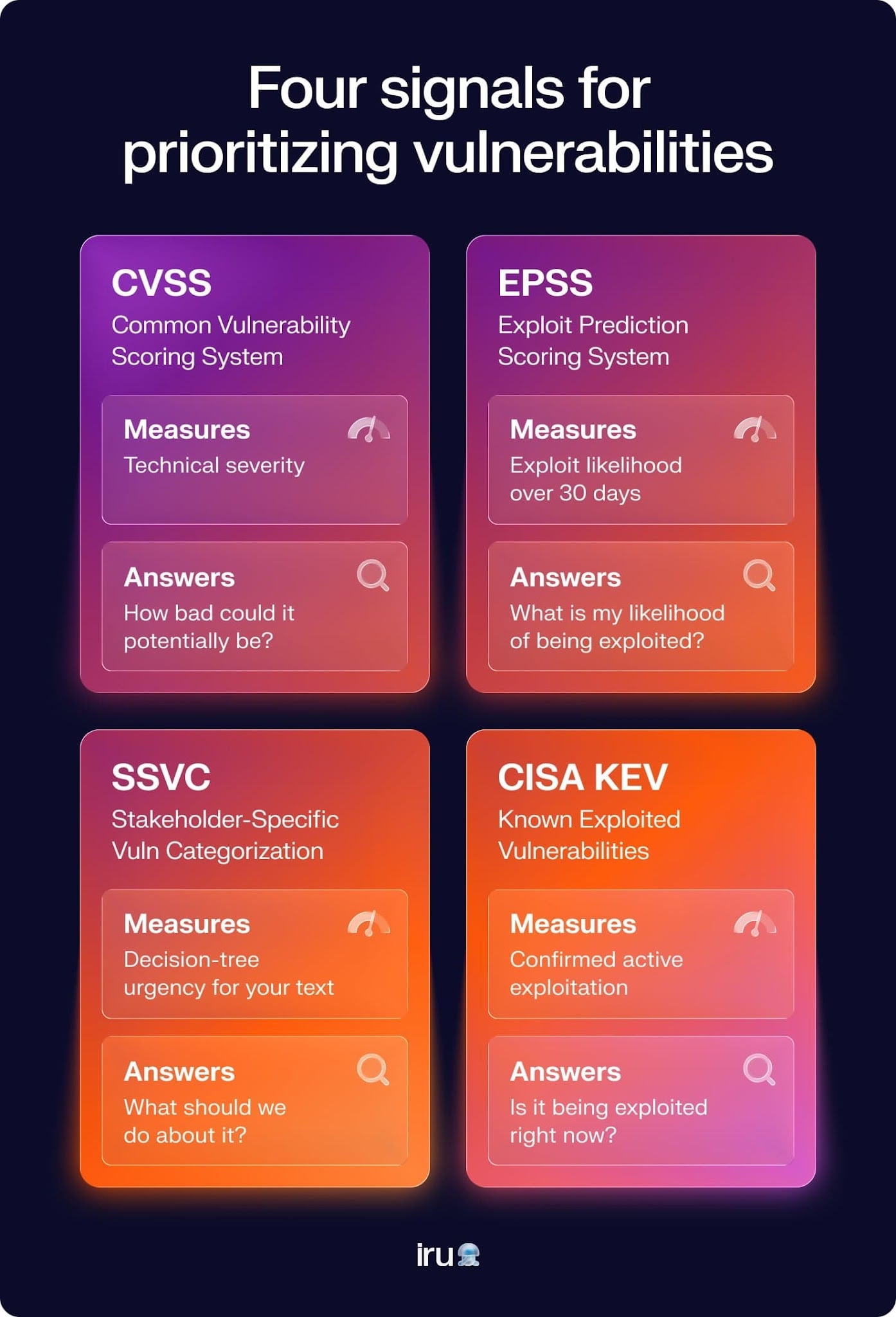
The NIST makes that limitation clear: The CVSS measures technical severity, not risk. A high score can signal serious potential impact, but the score alone doesn’t tell you how likely attackers are to exploit the vulnerability in your environment. That missing context can leave you chasing the loudest alarm while a more immediate threat waits nearby.
That focus on risk has also shaped federal policy. In June 2026, CISA issued Binding Operational Directive 26-04, which requires federal agencies to prioritize security updates based on risk. The directive considers signals such as asset exposure, Known Exploited Vulnerabilities (KEV) status, exploit automation, and technical impact.
CVSS still provides useful context, but effective prioritization needs a fuller picture of what could actually happen next.
Alternative vulnerability prioritization frameworks beyond CVSS
A CVSS score gives you one useful signal, but it can’t answer every question about a vulnerability. Other frameworks, such as the EPSS and SSVC, add context around exploit likelihood, active exploitation, and the potential impact on your organization.
Exploit Prediction Scoring System (EPSS)
EPSS predicts the likelihood that a publicly disclosed vulnerability will be exploited over the next 30 days. It updates scores daily using signals such as exploit code, threat intelligence, vulnerability characteristics, and observed exploitation activity.
In a real-time environment, EPSS can help you focus your attention on vulnerabilities that attackers are more likely to target. But the score still needs context from your own environment, including which affected software you use and how exposed it is.
That same context can feed into compliance automation, helping your security program connect vulnerability data with the actions and controls that follow.
Stakeholder-Specific Vulnerability Categorization (SSVC)
SSVC takes a different route. It uses a decision tree to help you determine how urgently to respond to a vulnerability based on factors specific to your situation, including exploitation status and the potential impact of a successful attack.
That makes SSVC useful after your vulnerability scanning process identifies an issue. Your team can use the framework to move beyond a raw score and decide on an appropriate response, from tracking the vulnerability to taking immediate action. The goal is to connect the vulnerability with the consequences it could create for your organization.
CISA Known Exploited Vulnerabilities (KEV) Catalog
KEV Catalog is a living list of vulnerabilities with evidence of active exploitation by attackers. A vulnerability’s presence in the catalog gives you a strong signal that attackers have already moved beyond theory and into action.
For your team, KEV can act as a fast lane in the prioritization process. When a vulnerable asset appears in your environment and the related CVE is in the catalog, that issue deserves immediate attention based on your exposure and risk.
Paired with controls such as Zero-Trust endpoint security, KEV data can help you focus your remediation efforts on threats with a proven track record of real-world exploitation.
How to prioritize vulnerabilities
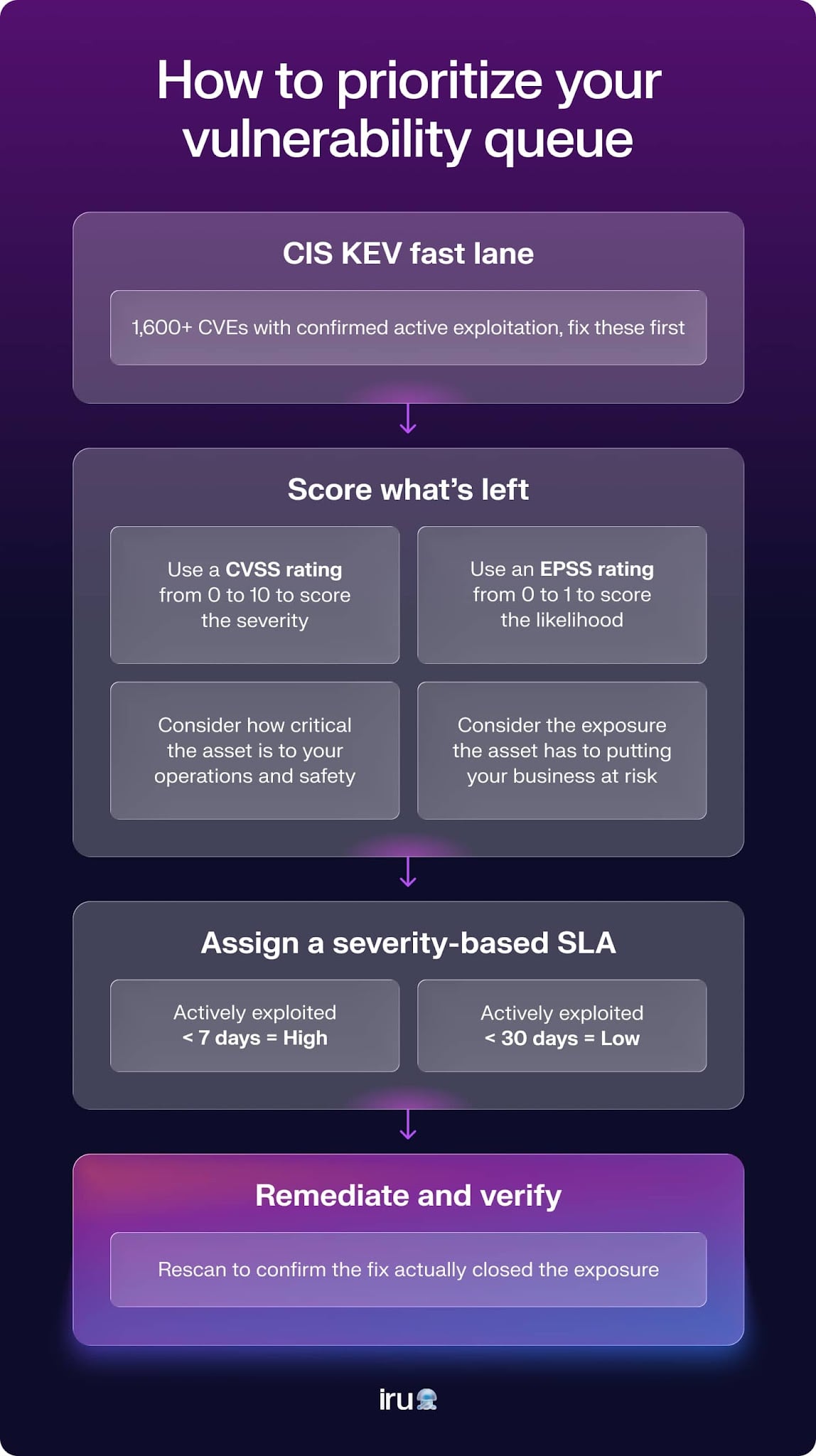
A clear process for prioritizing vulnerability remediation helps you turn a long list of vulnerabilities into a manageable queue. Endpoint vulnerability management (EVM) works best when you keep updating that queue as your environment and the threat landscape change.
Here’s how to prioritize vulnerability remediation:
- Build an asset and software inventory: You need to know which devices and software you have before you can judge which vulnerabilities affect your environment.
- Scan continuously. New vulnerabilities and software changes can appear at any time, so quarterly scans can leave you working with an outdated picture.
- Filter by CISA KEV first: If a vulnerability in the KEV Catalog affects your environment, move it to the front of the line because attackers have already exploited it in real-world attacks.
- Set severity and impact: Use the EPSS and CVSS as inputs to gauge exploit likelihood and technical severity, then consider the potential impact on your environment.
- Remediate and verify: Patch the vulnerability, then run follow-up scans to confirm the issue is actually fixed. Otherwise, you’re crossing your fingers and calling it a security strategy.
What to look for when prioritizing vulnerabilities
Every vulnerability comes with its own baggage. Endpoint visibility and control (EVC) gives you the context to figure out which issues could cause real damage and which can wait their turn.
Here’s what to keep in mind when prioritizing vulnerabilities:
- Active exploitation: Give immediate attention to vulnerabilities that attackers are already exploiting. Once attackers have a proven way in, the risk becomes much harder to ignore.
- Likelihood of exploitation: Look beyond severity scores to estimate the likelihood that attackers will exploit a vulnerability. A lower-severity issue with a high likelihood of exploitation can deserve faster action than a critical issue that attackers are unlikely to target.
- Asset criticality: Consider how important the affected device or software is to your business. For example, a vulnerability in a critical system can cause a much bigger problem than the same vulnerability in a device that plays a smaller role.
- Business impact: Consider what happens if attackers successfully exploit the vulnerability. Could it disrupt a key service, expose sensitive data, or bring an important part of the business to a halt?
- Exposure and severity: Once you understand the potential business impact, consider how exposed the asset is and how severe the vulnerability is. An internet-facing system with a severe vulnerability usually deserves more attention than one sitting behind layers of access controls.
- Fix feasibility: Factor in how quickly and safely you can address the issue. Some vulnerabilities have a straightforward fix, while others can become a larger project involving testing, planning, and potential downtime.
- Compensating controls: Use existing protections to limit exposure while you work on a permanent fix. These controls can also reduce risk when a patch isn’t available or the affected system can’t be updated. Sometimes, buying yourself time is the best move.
Common mistakes with vulnerability prioritization
Your vulnerability prioritization process can look solid on paper, yet still break down in practice if you overlook compensating controls or forget reachability. These missteps usually come from missing context, making assumptions, or losing track of what happens after you assign a priority.
Keep these traps in mind when reviewing your vulnerability queue:
| Mistake | What is it? | Solution |
|---|---|---|
| Relying solely on CVSS base scores | A CVSS score measures technical severity, but it can’t show the full risk to your environment. | Add context from exploit likelihood, asset exposure, and the systems affected before assigning a priority. |
| Chasing only “critical” labels | A critical label can grab attention, even when the affected vulnerability poses little immediate risk to your environment. | Look past the label and consider the evidence around the vulnerability before moving it to the top of the queue. |
| Forgetting reachability | A serious vulnerability matters less when attackers can’t realistically reach the affected system. | Check how an attacker could access the vulnerable asset and factor that path into your decision. |
| Overlooking compensating controls | Existing protections can reduce your exposure while you work toward a permanent fix. Ignoring them can push a vulnerability higher than its actual risk warrants. | Document the controls already in place protecting the asset, and reassess the priority based on the remaining exposure. |
| Treating the priority as permanent | Your environment keeps changing. A vulnerability can become more urgent when a device becomes exposed, a control changes, or new evidence appears. | Revisit open vulnerabilities as conditions change and update priorities accordingly. |
| Assuming remediation is the finish line | Applying a patch doesn’t guarantee that the vulnerability is gone. Failed deployments and incomplete updates can leave the door open. | Verify the fix with follow-up scans and keep the vulnerability open until you confirm the affected asset is no longer exposed. |
Iru MCP helps reduce some of the manual work behind these decisions. It lets you query Iru data and manage endpoint workflows from MCP-compatible AI tools, so you can build workflows that pull vulnerability data, investigate affected devices, and connect the findings to the systems your team already uses.
Automate vulnerability prioritization with Iru
A long list of vulnerabilities still leaves you with the hard part: deciding where to focus. Iru’s vulnerability management software brings more context into that process, helping you identify vulnerable software across your environment and prioritize remediation based on immediate risk.
Iru gives you visibility into affected software, helps you assess the impact and required fixes, and supports automated patching for vulnerable apps. Then there’s Iru AI, which enriches vulnerability data from sources across the CVE ecosystem to improve detection context.
Take control of your vulnerability backlog before it starts controlling your team. Book a free demo to see how Iru can help you prioritize vulnerabilities and remediate them faster.