
 Workforce Identity
 Endpoint Management
 Endpoint Detection & Response
 Vulnerability Management
 Compliance Automation
 Trust Center





Endpoint vulnerability management (EVM) is the process of identifying, evaluating, prioritizing, and remediating security weaknesses on your endpoints before attackers can exploit them.
Modern endpoint fleets are constantly changing. New devices come online, software updates roll out at different times, and vulnerabilities appear every day. For context, 2025 saw 49,183 new Common Vulnerabilities and Exposures (CVEs).
Without a reliable way to track what's exposed, you can waste valuable time piecing together information from multiple tools instead of responding to actual risks. Endpoint vulnerability management (EVM) solves this problem by helping you continuously identify, assess, prioritize, and remediate vulnerabilities across your endpoints.
In this post, we discuss how the process works and why it's essential for modern security teams. We’ll also share some best practices for improving your organization's security posture.
Why is endpoint vulnerability management important?
Endpoint vulnerability management helps you stay ahead of emerging threats and strengthens your security. It's a core part of effective threat and vulnerability management and supports a stronger Zero Trust endpoint security strategy.
EVM matters because it:
- Strengthens security: It continuously scans endpoints for known vulnerabilities and helps close security gaps before attackers can exploit them.
- Improves threat detection: EVM gives you better visibility into vulnerable devices, making it easier to identify suspicious activity and respond faster.
- Manages compliance: It helps you meet regulatory and internal security requirements by maintaining visibility into vulnerabilities and documenting remediation efforts.
- Reduces risk: It prioritizes vulnerabilities based on severity and business impact, so teams can focus on fixing the issues that matter most.
- Limits operational downtime: EVM fixes vulnerabilities before they cause security incidents, minimizing disruptions to employees and business operations.
- Automates patch management: You can automatically deploy approved patches across endpoints, reducing manual work and helping critical updates reach devices faster
- Improves productivity: It reduces the time spent tracking vulnerabilities across multiple tools, allowing your IT and security teams to focus on higher-value work
Iru simplifies EVM by automatically patching supported applications and helping you stay compliant with endpoints. You also get the visibility you need to reduce risk across distributed environments.
Common endpoint vulnerabilities
Understanding the most common endpoint security vulnerability types helps you prioritize remediation efforts and strengthen your overall vulnerability response process.
Keep an eye out for:
- Unpatched operating systems and applications: Missing security updates leave known vulnerabilities exposed long after fixes are available.
- Weak or stolen credentials: Easy-to-guess passwords, reused credentials, and compromised accounts give attackers a direct path to endpoint access.
- Security misconfigurations: Incorrect security settings, unnecessary permissions, or open ports can create exploitable weaknesses.
- Shadow IT: Unauthorized applications and devices operate outside IT oversight, increasing your organization's attack surface.
- Unsecured devices: Endpoints without antivirus, firewalls, or endpoint protection are easier for attackers to compromise.
- Internet of Things (IoT) devices: Connected printers, cameras, sensors, and other IoT devices often receive infrequent updates and can become entry points into the network.
- Zero-day exploits: Attackers may exploit previously unknown vulnerabilities before vendors release patches or mitigations, making rapid vulnerability response essential.
- Lack of device encryption: Unencrypted endpoints put sensitive business data at risk if a device is lost, stolen, or accessed by unauthorized users.
- Security exclusions: Overly broad or outdated security exclusions can leave files, folders, or applications unprotected, creating blind spots that attackers may exploit.
How endpoint vulnerability management works
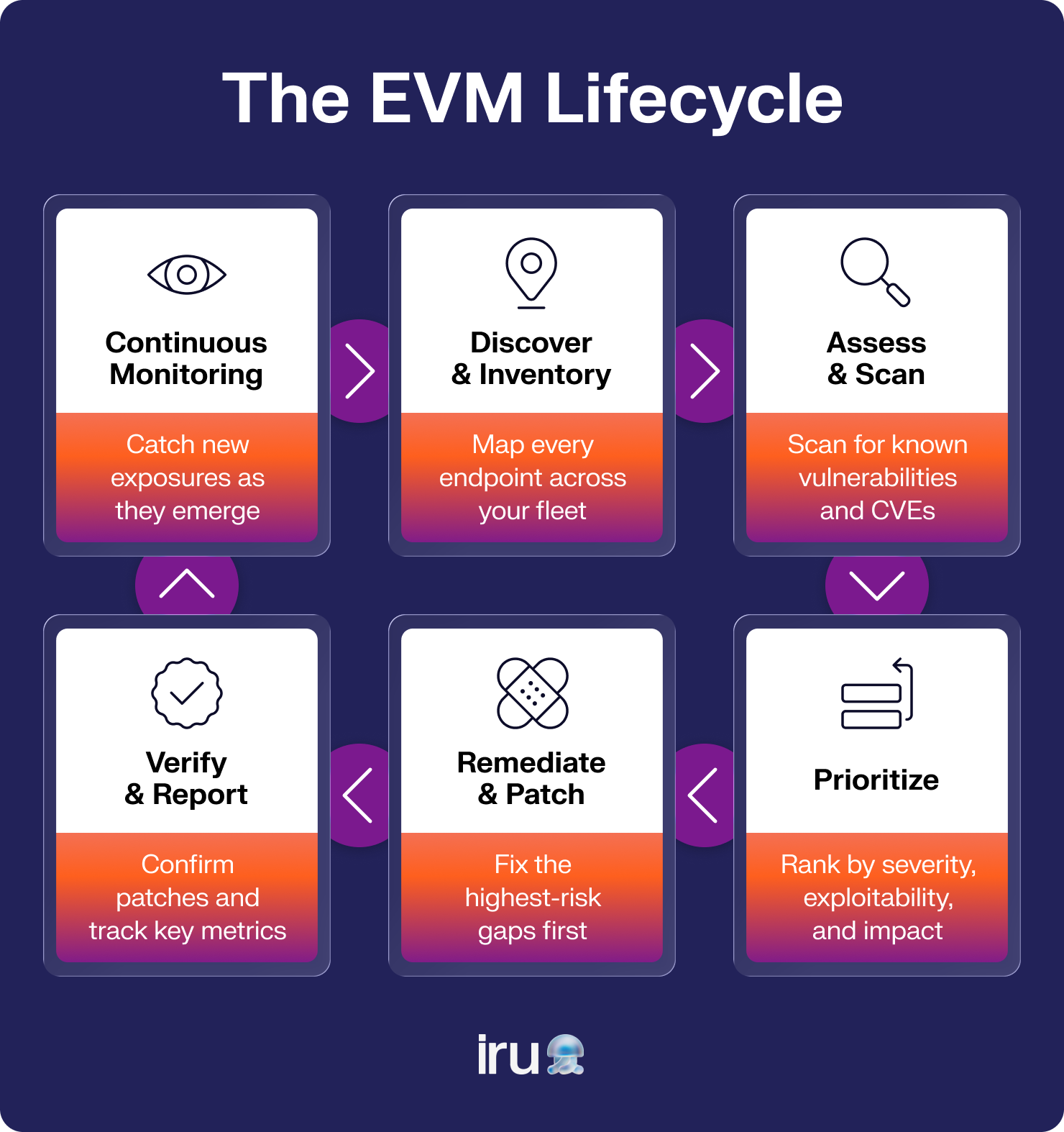
EVM begins by identifying every endpoint in your environment. It then moves through discovery, assessment, prioritization, remediation, verification, and ongoing monitoring. These steps help you reduce risk before vulnerabilities become security incidents.
Discover and inventory
The first step is building a complete inventory of every endpoint connected to your organization, including laptops, desktops, servers, virtual machines, mobile devices, and supported IoT devices. This inventory forms the foundation of any cybersecurity risk assessment, helping you understand which assets need protection.
Discovery looks different depending on your environment:
- On-premises organizations often rely on network-based discovery.
- Remote workforces require cloud-based endpoint management that keeps visibility even when devices rarely connect to the corporate network.
- Hybrid environments combine both approaches, ensuring every endpoint is accounted for regardless of location.
Assess and scan
Once your inventory is complete, scan your endpoints for known vulnerabilities. If a high-severity CVE is announced, immediately assess endpoints running the affected software instead of waiting for the next scheduled scan.
Outside of emergencies, you should establish a scanning schedule based on factors such as business risk, device types, compliance requirements, and the sensitivity of the data stored on endpoints.
Some environments benefit from frequent, lightweight scans, while others schedule deeper scans that examine operating systems, applications, firmware, and configurations. Combined with endpoint monitoring, these assessments provide an up-to-date view of your organization's exposure.
Prioritize
After scanning, categorize findings by severity, exploitability, affected devices, business impact, and likelihood of exploitation. This helps you focus limited resources where they'll have the greatest impact.
For example, if a newly disclosed CVE only affects a browser extension installed on your company's MacBooks. Those endpoints should move to the top of your remediation queue, while unaffected Windows servers can remain a lower priority.
Many organizations combine this risk-based approach with an endpoint protection platform to gain additional context for remediation decisions.
Remediate and patch
With priorities established, begin remediating the highest-risk vulnerabilities first. In many cases, this means deploying software or operating system patches, but remediation may also involve changing security configurations, removing vulnerable applications, disabling unnecessary services, or isolating affected endpoints until a permanent fix is available.
Modern endpoint management platforms, such as Iru, reduce manual effort by automating much of this process. Iru helps you automatically deploy approved patches across managed endpoints, making it easier to remediate vulnerabilities quickly while maintaining consistent security policies across distributed device fleets.
Verify and report
Run follow-up scans to verify that your team installed patches successfully and to identify any failed deployments. Also, ensure that your endpoints remain compliant with internal security standards. For organizations using Mac patch management, verification is especially important to confirm Apple updates have been applied consistently across managed devices.
Track key metrics over time to measure the effectiveness of your EVM program, including:
- Mean time to detect (MTTD)
- Mean time to remediate (MTTR)
- Patch compliance rate
- Vulnerability detection rate
- Vulnerability recurrence rate
- Percentage of critical vulnerabilities remediated within service level agreements (SLAs)
- Failed patch deployment rate
Continuous monitoring
Continuous monitoring helps you quickly identify new exposures and maintain a strong security posture through automated endpoint management.
A few best practices to follow:
- Schedule routine vulnerability scans during off-peak hours to reduce user disruption.
- Exclude business-critical devices from intensive scans during working hours when performance is a concern.
- Automatically discover newly enrolled devices so they enter the vulnerability management workflow immediately.
- Review vulnerability trends regularly to identify recurring issues and improve remediation processes.
- Continuously update vulnerability signatures and threat intelligence to detect newly disclosed risks as quickly as possible.
Endpoint vulnerability management vs. (traditional) vulnerability management
Traditional vulnerability management covers the entire IT environment, including cloud infrastructure, web applications, networks, containers, and code repositories. It also maps attack surfaces to identify exposed services, open ports, and security misconfigurations.
EVM is one part of a broader threat vulnerability management program. It focuses specifically on employee devices. It identifies vulnerable software, missing patches, insecure configurations, and other endpoint risks.
Unlike traditional vulnerability management, EVM typically doesn't map attack paths across the entire environment. Instead, it's often built into endpoint management, endpoint detection and response (EDR), or extended detection and response (XDR) platforms to continuously protect managed devices.
Best practices for endpoint vulnerability management
An effective EVM program goes beyond running regular scans. It requires accurate asset visibility, risk-based prioritization, automated remediation, and consistent security policies to keep your endpoint fleet protected as it grows. Here are some best practices that can help.
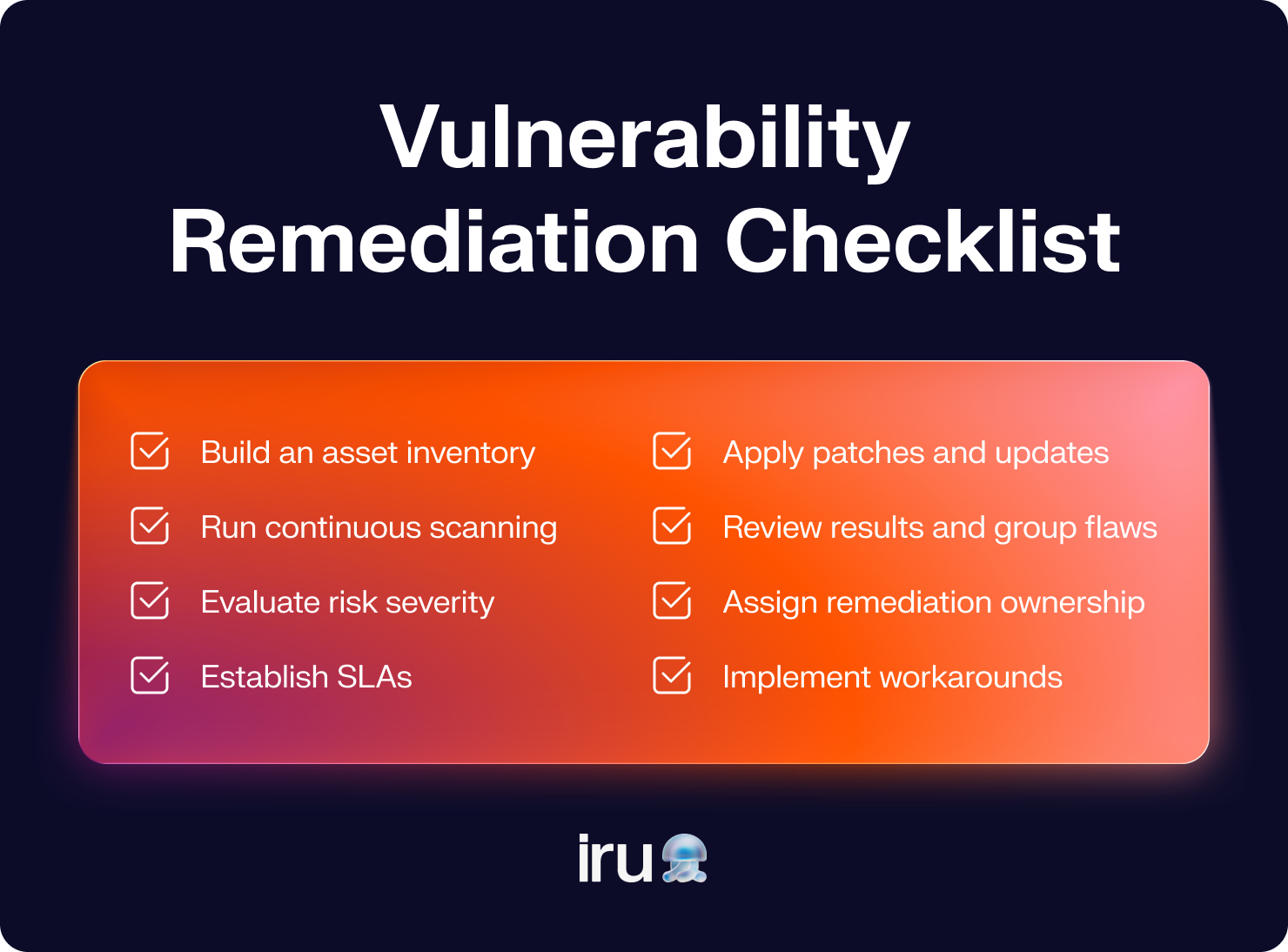
Maintain a real-time asset inventory
Automatically track every managed device as it enrolls, so laptops and mobile devices enter your inventory the moment they’re set up. For unmanaged or network-only assets, agentless discovery can fill the gaps. Tag each asset with an owner and a risk level so you know what to prioritize when a vulnerability lands.
For example, if a critical browser vulnerability is disclosed, you can quickly identify every affected device instead of manually piecing together inventory data.
Prioritize using threat intelligence
It's impossible to patch every vulnerability immediately, so focus on the ones that present the greatest real-world risk.
Use threat intelligence to identify CVEs that are actively being exploited, then factor in asset criticality. A vulnerable device containing sensitive business data should take priority over a low-risk test machine.
That way, your security teams spend their time reducing the greatest risks instead of simply working through a long list of vulnerabilities.
Implement automated patch management
Automation reduces your window of exposure by deploying updates quickly and consistently.
Define patching SLAs for critical and low-risk vulnerabilities, test updates in a staging environment, and maintain a rollback plan in case a patch causes unexpected issues. This helps critical patches reach hundreds or even thousands of endpoints without requiring manual intervention from IT.
Iru simplifies this process with automated application patching and centralized policy management, helping you remediate vulnerabilities faster while reducing manual effort.
Enforce least privilege and configuration management
Limit local administrator privileges, disable unnecessary services and legacy protocols, and align devices with security baselines such as Center for Internet Security (CIS) Benchmarks.
Regular configuration reviews also help prevent endpoint drift and reduce tool sprawl, making your environment easier to secure and manage. On top of that, it reduces the chances of users accidentally installing unauthorized software or changing security settings that increase risk.
Effectively manage your endpoints with Iru
As endpoint fleets grow, keeping devices secure becomes increasingly difficult without the right tools. Iru’s EDR solution brings endpoint and vulnerability management together in a single platform, so you can manage vulnerabilities across Mac and Windows devices with greater visibility and control.
You get features like automated patching, continuous threat detection, and centralized policy management that help reduce risk while simplifying day-to-day endpoint management.
Book a free demo to see how Iru can help secure your entire device fleet.