




A vulnerability management maturity model (VMMM) gives you a way to measure how advanced your organization's vulnerability management program is and what it needs to improve. It’s like a progress report for your security practices, showing where your team stands today and what steps can help you reach the next level.
Vulnerability scanning can reveal hundreds or thousands of security weaknesses across your organization, but finding vulnerabilities is only the first step. Without a clear process for deciding which issues to fix first, assigning responsibility, and tracking progress, you can spend hours reviewing scan results while critical risks remain unresolved.
A vulnerability management maturity model (VMMM) shows you how well your current program performs and identifies areas for improvement. With a VMMM, you can move from reactive fixes toward a more planned, risk-based approach. Below, we’ll break down what a VMMM looks like and how you can advance your program.
What is a vulnerability management maturity model?
A vulnerability management maturity model gives your security team a framework for evaluating how well its vulnerability management practices work. It looks at the processes behind the work, from preparing to identify weaknesses to deciding how to treat them.
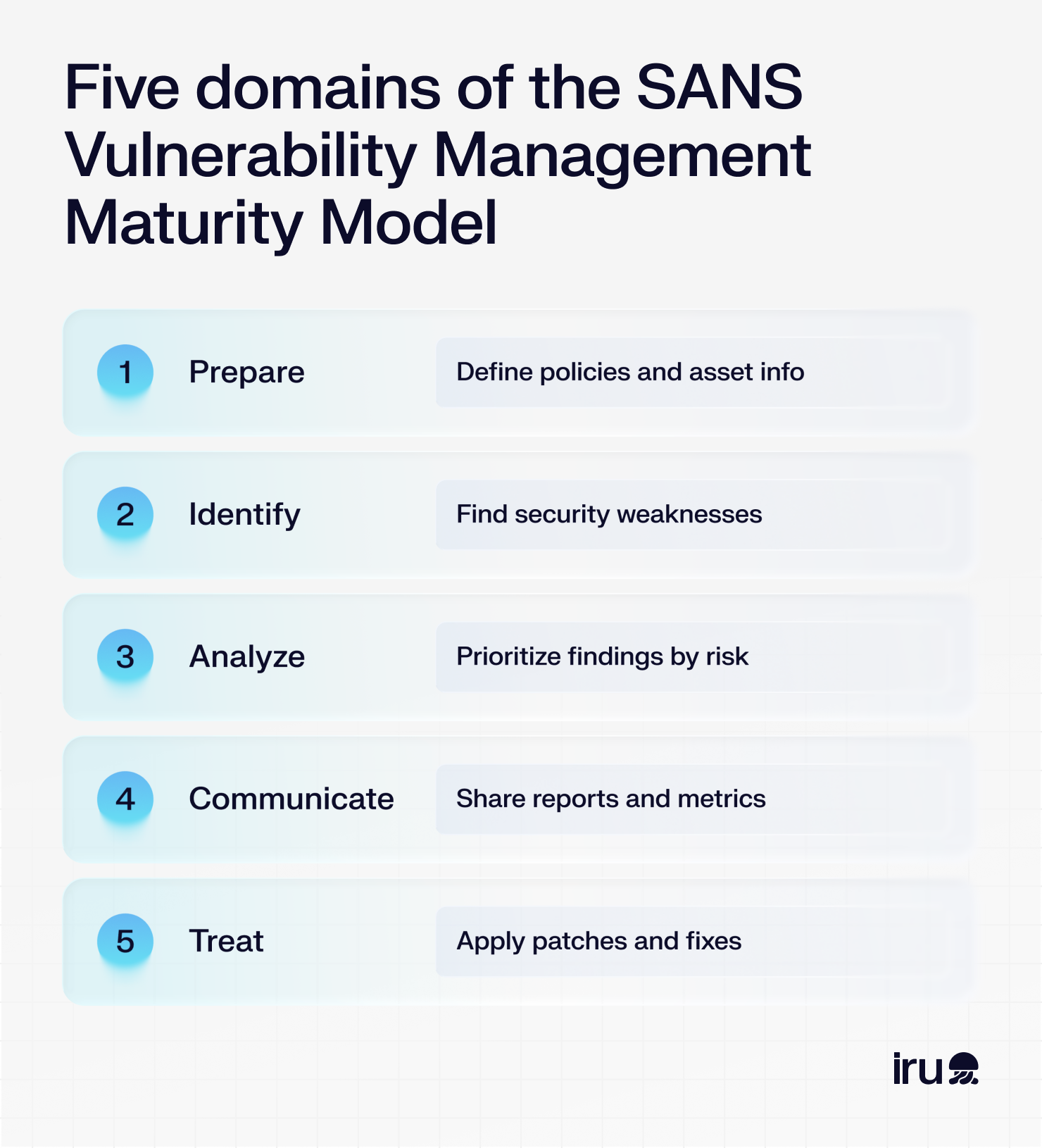
One established example is the SANS Vulnerability Management Maturity Model, which organizes vulnerability management into five process areas: prepare, identify, analyze, communicate, and treat (PIACT).
The SANS maturity model also has a self-assessment tool that examines 12 focus areas, such as automated identification and patch management, helping you evaluate your current capabilities and pinpoint where your program needs improvement.
The five domains every maturity level is measured across
Each process area in SANS’s PIACT framework covers a different part of the process, from laying the groundwork to fixing security weaknesses. They show you how well your program handles each stage of vulnerability management:
- Prepare: Before your team can tackle vulnerabilities, it needs a plan. This domain covers the policies, standards, and asset information that guide your program, including which systems deserve the most attention.
- Identify: You can’t fix a vulnerability you don’t know exists. Under this domain, the focus is on finding weaknesses across your environment through vulnerability scans and other assessment methods, giving your team a clearer view of potential problems.
- Analyze: A long list of vulnerabilities can make every issue look urgent. The Analyze domain helps your team sort through the findings, assess their significance, and decide what deserves attention first. It also looks at recurring problems that may point to deeper issues.
- Communicate: Finding a vulnerability is only part of the job. The people responsible for fixing it need to know what’s wrong, why it matters, and what action to take. This process area covers reporting and metrics, plus the communication that keeps everyone on the same page.
- Treat: The Treat domain covers how your team addresses vulnerabilities through patching, configuration changes, and other fixes. It also considers how you manage those changes so that fixing one problem doesn’t create another.
Iru’s Vulnerability Management software can help you put these principles into practice by giving you visibility into software vulnerabilities across your devices. And with Iru AI, you can prioritize vulnerabilities and automate patching, so your team can turn findings into action.
The five levels of vulnerability management maturity
Each domain of SANS’s PIACT framework is measured across five different maturity levels. The five levels below follow the SANS VMMM. Other vendors may use different labels or stages, so these levels are not a universal standard. Your program may also show different levels of maturity across each of the five PIACT domains.
Level one: Initial
At this stage, vulnerability management tends to happen on the fly. Your team might run scans to meet a compliance requirement or respond to a security incident, but you lack a consistent process for handling the results. Policies may be missing, responsibilities remain unclear, and fixes depend on who spots a problem first.
You’re getting started, and even basic scanning can reveal useful information. The challenge is turning those findings into repeatable action. Without clear ownership or a defined process, vulnerabilities can sit unresolved while your team deals with the latest urgent request.
Level two: Managed
Your team starts putting basic processes in place, often after an audit or a problem exposes a weakness. You may document policies for certain tasks and assign people to handle specific findings. The process is becoming more organized, although different teams may still handle vulnerabilities in different ways.
You also begin improving vulnerability prioritization by looking beyond severity scores. For example, you might check whether an attacker can exploit a vulnerability or whether a patch is available. These details help your team make better decisions, even if the overall process still relies heavily on manual effort.
Level three: Defined
By level three, your team follows a documented vulnerability management process built around recognized security practices. Policies cover the key stages of the work, and employees know what the process requires of them. Training also helps teams understand their responsibilities.
Vulnerability management now follows a consistent plan across your organization. You have clear rules for handling findings, and your team can explain how it decides what to fix and when. There’s still room to improve how you measure results, but you have a reliable foundation to build on.
Level four: Quantitatively managed
By level four, your team measures how well the program performs. You track whether teams follow established policies and monitor metrics such as remediation times and overdue vulnerabilities. When performance falls short of expectations, you have data to help identify the cause.
Those measurements give you a clearer view of where the process works and where it needs attention. You can spot recurring delays, investigate why certain vulnerabilities remain open, and use the findings to improve performance. Decisions increasingly rely on evidence rather than guesswork.
Level five: Optimizing
At the highest level, your team continually improves the program using performance data and lessons from past results. Policies evolve as your environment changes, while proactive controls help enforce requirements and flag exceptions before they become bigger problems.
Automation also takes on more of the routine work. Automated patch management, for instance, can help your team deploy approved software updates with less manual effort. Your team still needs to oversee changes and handle exceptions, but it can spend more time addressing complex risks and improving the program.
Reaching level five means building a process that keeps adapting as new vulnerabilities and business needs emerge.
How to assess your current maturity level
Start with the free SANS VMMM-SAT 2.0, an interactive Excel tool that uses yes-or-no questions to assess your program across the model’s 12 focus areas. It also provides a summary of your maturity across the five levels, giving you a good starting point for deciding what to improve.
Use the assessment alongside these questions to check how your program performs in practice:
- Prepare: Can you produce a complete inventory of your organization's software and endpoints today?
- Identify: Do your endpoint security tools give you visibility into vulnerabilities across your environment?
- Analyze: Can you explain how your team prioritizes vulnerabilities based on risk, exploitability, and business impact?
- Communicate: Do teams know who owns each vulnerability and when it needs to be resolved?
- Treat: Do you track the mean time to remediate (MTTR) critical Common Vulnerabilities and Exposures (CVEs), and can you report the results for the previous quarter?
As you score your program, keep a few rules in mind:
- Score each domain separately. A strong performance in one area can mask weaknesses in another. Use your weakest domain as the starting point for your overall maturity assessment.
- Turn the results into a working document. You can adapt the assessment into your own SANS vulnerability management maturity model PDF by exporting your completed results and adding your team's findings, priorities, and next steps.
- Repeat the assessment quarterly. Track each domain's score over time and share the trend with leadership. That way, you can show where the program is improving and where it still needs attention.
How to move up a maturity level
Moving up a level takes focused improvements across all five PIACT domains. The SANS VMMM provides a framework for understanding how vulnerability management practices evolve as a program matures. The recommendations below build on that framework, offering practical steps your team can take to improve its processes.
Teams can get stuck at different points as their vulnerability management program matures. Here are common obstacles at each transition. The sections that follow outline steps to help your team move past them.
| Maturity transition | Where teams tend to get stuck |
|---|---|
| Level 1 → 2: Initial to managed | Reactive work crowds out planning. Teams scan after an incident or audit, but lack clear ownership and repeatable routines. Vulnerabilities compete with other urgent tasks, so follow-through is inconsistent. |
| Level 2 → 3: Managed to defined | Processes exist, but vary across teams. One department may follow a documented scanning schedule while another handles findings on an ad hoc basis. Without shared standards, results and remediation practices remain inconsistent. |
| Level 3 → 4: Defined to quantitatively managed | Consistency is hard to measure. Teams follow documented processes but lack reliable metrics to show how well those processes work. Without clear performance data, recurring delays and gaps in scan coverage can go unnoticed. |
| Level 4 → 5: Quantitatively managed to optimizing | Measurement doesn’t always lead to improvement. Teams collect performance data but struggle to turn it into preventive action. Manual handoffs and slow remediation workflows can persist, even when metrics show where the problems lie. |
From level one to level two
Your first goal is to replace ad hoc responses with repeatable routines. Start with the lessons your team has learned from past incidents, then establish a process everyone can follow when new vulnerabilities appear.
Here’s how it should go:
- Prepare: Define the behaviors and procedures needed to prevent problems that have caused harm in the past.
- Identify: Establish regular tasks for finding vulnerabilities across your environment, using endpoint monitoring to improve visibility into potential issues.
- Analyze: Create basic categories for findings and sort them by urgency.
- Communicate: Share vulnerability details with the teams responsible for resolving them.
- Treat: Establish a remediation workflow that your team can repeat for each new finding.
From level two to level three
Now that your team has basic routines, the next step is to make those routines consistent across the organization. Document your expectations and give every team a shared process to follow.
Here’s how this might look in action:
- Prepare: Select baseline security frameworks to guide your vulnerability management standards.
- Identify: Set a required scanning schedule that covers your organization's environment.
- Analyze: Build a repeatable matrix for prioritizing vulnerabilities using consistent criteria.
- Communicate: Define SLAs for remediation and create standard reporting templates.
- Treat: Integrate vulnerability remediation into your existing change management and patch management workflows.
From level three to level four
At this stage, your team has a defined process. Now you need evidence that the process works and where it can be improved. Start measuring performance across the program so you can spot weak points and make decisions based on results.
Here’s how to do it:
- Prepare: Track compliance with your documented policies and standards.
- Identify: Measure how much of your environment scanning covers and how effectively your tools detect vulnerabilities.
- Analyze: Review vulnerability trends to identify recurring problems and guide preventive action.
- Communicate: Build operational dashboards that show measurable results, such as remediation times and scan coverage.
- Treat: Find bottlenecks in deployment pipelines and identify what delays remediation.
From level four to level five
Your team now has the measurements it needs to improve performance. The next step is to use those insights to drive more proactive decisions and automate routine work. Human oversight still matters, especially when a change could disrupt critical systems.
Your steps should look like this:
- Prepare: Automate policy enforcement so your team can catch and address violations earlier.
- Identify: Integrate vulnerability discovery into build-and-release pipelines to find weaknesses earlier in software development.
- Analyze: Develop executive-level models that show how vulnerability management reduces risk across the organization.
- Communicate: Use real-time, context-aware routing and automated alerts to send findings to the right people.
- Treat: Enable automated patching and self-healing environments where appropriate, with safeguards for changes that require human review.
Endpoint vulnerability management (EVM) can support this progress by helping your team identify and address software vulnerabilities across endpoints.
Mature your vulnerability management program with Iru
Vulnerabilities have a knack for showing up when your team already has a full plate. A vulnerability management maturity model gives you a clearer view of your program’s strengths and weaknesses, helping you identify what needs attention and where to direct your efforts. Iru can help you put those insights into action.
Iru’s Vulnerability Management software gives you visibility into software risk on Mac and Windows and uses Iru AI to prioritize vulnerabilities and automatically patch vulnerable software. You can use Iru to make vulnerability remediation a more consistent part of your security workflow, with less manual effort required to keep vulnerable software up to date.
If you’re curious how, book a free demo to see how Iru can support your vulnerability management program.