
Skip to content
WWDC 2022: Apple Advances Declarative Device Management
Iru Team

5 min read

WWDC 2022: Apple Advances Declarative Device Management

Last year, at WWDC 2021, Apple introduced a new concept for Apple admins: Dubbed declarative device management (a.k.a. declarative MDM), it was an evolutionary advance of the MDM protocol. The declarative model is designed to push much of the management down to the device itself. Instead of a server polling a device for its status and issuing commands to it (as happens with the current MDM protocol), declarative device management lets the device react to its own state changes by applying management on its own. This year, at WWDC 2022, Apple announced an expansive update to declarative MDM: Where the original iteration worked only on iOS and iPadOS devices with user enrollment, it will now work on all Apple platforms, including Mac and Apple TV, and with all enrollment types. It also added new status reports and improved syntax for rules that define how a device is to be managed.

Recent News
Updated Wi-Fi Library Item Enhances Support for Enterprise Security
Iru Team

2 min read

Updated Wi-Fi Library Item Enhances Support for Enterprise Security

As workers return to the office, managing their access to company Wi-Fi is once again top-of-mind for many Mac admins. It’s been top of mind for Kandji, too: We’ve updated and expanded our Wi-Fi Library Item to better support enterprise networking—in particular the many authentication protocols those networks use.

Product Update
WWDC 2022: How Apple Plans to Make True Single Sign-On a Reality
Iru Team

4 min read

WWDC 2022: How Apple Plans to Make True Single Sign-On a Reality

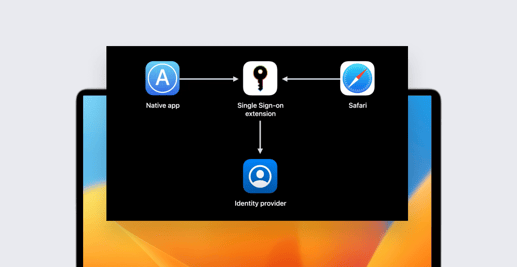
For Mac admins, single sign-on (SSO) sounds like a great idea. In that ideal world, a user would turn on their Mac computer, sign in with their credentials, and then—with that one sign-in—have access to everything: their local user account; apps on their device; resources you provide on the local network; and apps and services that reside in the cloud. So far, though, that ideal has remained out of reach. The user still has to sign in first to a local account, then again to apps and services. SSO services such as Okta and OneLogin make that easier, by providing a single login for cloud-based resources. But true single sign-on isn’t here yet.

Recent News
Create Multiple Instances of Auto Apps and Managed OSes
Iru Team

1 min read

Create Multiple Instances of Auto Apps and Managed OSes

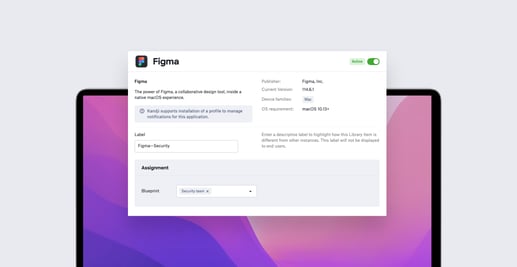
Kandji makes it simple to configure and deliver applications and operating systems to end-user devices. You just select the appropriate Auto App or Managed OS Library Item, set it up the way you want, then assign it to a Blueprint. Any device assigned to that Blueprint will then get the software you want, the way you want it.

Product Update
New Recovery Password Library Item Thwarts Unauthorized Startups
Iru Team

2 min read

New Recovery Password Library Item Thwarts Unauthorized Startups

Kandji's new Recovery Password Library Item allows you to configure and apply recovery passwords (to Mac computers with Apple silicon) and EFI firmware passwords (for Intel-based Mac computers), in order to protect against unauthorized startup commands.

Product Update
PacketFence Integration with Kandji Bolsters Network Security
Iru Team

1 min read

PacketFence Integration with Kandji Bolsters Network Security

Kandji now integrates with PacketFence, the free, open-source network access control (NAC) solution that allows admins to effectively secure networks of all sizes. The integration ensures that the Kandji Agent is installed properly on devices and that those devices are then accessing the network securely.

Product Update
How Mac Admins Are Managing the Hybrid Workplace
Iru Team

5 min read

How Mac Admins Are Managing the Hybrid Workplace

Two years ago, IT departments all over the world got a crash course in managing remote workforces. Mac admins had to quickly figure out how to keep employees equipped, connected, and secure, regardless of where they were physically located. Last year, many organizations that had made the switch to remote started to cautiously reopen, allowing (or, in some cases, requiring) workers to come into the office at least part of the time. That reopening waxed and waned through 2021, as conditions allowed. But in the meantime, a new kind of office evolved: the hybrid workplace, in which some employees worked remotely, some worked in the office, and many did a bit of both. In the course of that evolution, what was once a temporary expedient became a new way of doing business—thanks in no small part to the adaptability of IT.

Recent News
New Option Gives Admins Finer Control Over Auto App Notifications
Iru Team

1 min read

New Option Gives Admins Finer Control Over Auto App Notifications

We’ve updated Auto Apps to give admins greater control over the notifications those apps generate for users.

Product Update
Foqal's Kandji Integration Feeds Device Details to Support Tickets, Slack
Iru Team

2 min read

Foqal's Kandji Integration Feeds Device Details to Support Tickets, Slack

Kandji now integrates with Foqal Agent, the service-desk and automation tool that lets IT admins use Slack to create support tickets—either in Foqal’s ticketing system or another. Foqal uses its Kandji integration to display device details in support tickets; it also enables IT admins to take action on managed Apple devices and to act on tickets without leaving Slack or the ticketing system.

Product Update
New Integrations Interface Streamlines Connecting to Third-Party Services
Iru Team

1 min read

New Integrations Interface Streamlines Connecting to Third-Party Services

Kandji has completely revamped the Integrations section of our web app. That section, where you configure the integration of third-party apps and services with Kandji, has been moved out of Settings to a section of its own.

Product Update
Apple Removing Python 2.7: What Admins Need to Know and Do
Iru Team

6 min read

Apple Removing Python 2.7: What Admins Need to Know and Do

It shouldn’t surprise anyone that Apple is removing Python 2.7 from the upcoming macOS 12.3 release: As far back as 2019, the company said it was deprecating the scripting and programming language and that Python would not be included with future versions of the OS. Now Apple is simply making good on that promise.

Recent News
How to Be an IT Hero: Creating the Best User Experience
Iru Team

8 min read

How to Be an IT Hero: Creating the Best User Experience

At the end of the day, what is a Mac admin’s primary responsibility? To deliver hardware? To maintain security? To just keep the trains running? Some would argue that the real goal is to keep users happy, from their day-one onboarding through their entire lifecycle with the organization. But how do you create user experiences that will keep employees—and leadership—happy? That was the question we asked at a recent Kandji panel discussion, “The IT Hero’s Quest: Deliver the Best Experience for Mac Users.” Hosted by Steven Vogt (Senior Product Engineer), the guests were Michael Tsai (Senior Product Manager at Kandji) and Charlie Klausen (IT Manager at Forward Financing). All three have many, many years of experience working with and as IT admins. All three had plenty to say about how and why admins should make great end-user experiences their primary goal.

Recent News
Hybrid Workplace Boosts Demand for Apple Devices Among UK Businesses
Iru Team

2 min read

Hybrid Workplace Boosts Demand for Apple Devices Among UK Businesses

Last year, Kandji commissioned a survey to find out how IT admins and leaders in the United States were dealing with the new hybrid workplace—in which some employees work remotely, some are in the office, and many do both. That survey found that the shift to hybrid work over the past two years coincided with increased demand for Apple devices among business users. It turns out that the correlation between hybrid work and Apple demand isn’t just a U.S. phenomenon: A new Kandji-commissioned survey of 250 senior IT decision-makers and more than 1,000 remote and hybrid workers in the United Kingdom found much the same is true there.

Recent News
Drata Integration with Kandji Automates Mac Security Monitoring
Iru Team

2 min read

Drata Integration with Kandji Automates Mac Security Monitoring

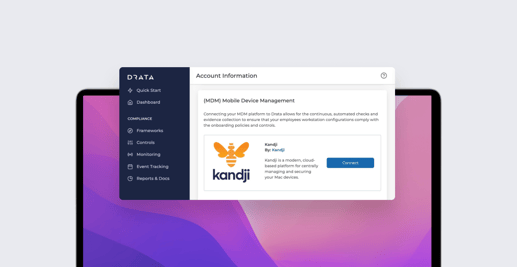
Drata is a fast-growing SaaS company that provides seamless compliance with SOC 2, ISO 27001, PCI DSS, and HIPAA, by automating the process of collecting evidence across an organization’s tech stack. That evidence allows companies to prove their security posture and pass audits; automating the process can significantly reduce the time companies spend achieving and monitoring compliance. Drata automates its evidence collection by connecting with more than 50 cloud-based tools—business suites, identity management providers, and the like. Proving that end-user devices are secure also plays a major role in meeting compliance requirements. That's why Drata recently enabled an integration with Kandji that extends those monitoring abilities to Mac computers. Instead of installing an agent to monitor Mac security settings, Drata can pull the data from Kandji via API.

Product Update
How to Achieve Your Desired End-State Through Auto-Remediation
Iru Team

8 min read

How to Achieve Your Desired End-State Through Auto-Remediation

How do you want the devices you manage to be configured? What settings do you want to be enforced, which apps do you want to be installed, how often should the OS be updated—in other words, what is the end-state that you want to achieve? And how are you going to achieve it? Those were the questions that Arek Dreyer and Matt Wilson—senior product engineers at Kandji—discussed at our recent live event, “A Deep Dive into Auto-Remediation.” They’re questions that every Mac admin asks—and is asked—on a regular basis. Arek and Matt looked at the ways Kandji can help you achieve the end-state you want for the Apple devices you manage.

Recent News

Stay up to date

Iru's weekly collection of articles, videos, and research to keep IT & Security teams ahead of the curve.